
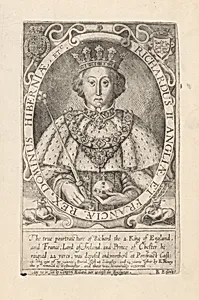
Richard II, King of England
Medium
Classification
Department
Smithsonian Collection
Museum
Smithsonian American Art Museum
Credit
National Portrait Gallery, Smithsonian Institution
Accession Number
S/NPG.77.43.13
Rights
Public Domain
Tags
Art Historical Context
Behold the striking 1618 engraving *Richard II, King of England by Renold Elstr, a master English printmaker active around 1570–1625. This portrait captures the deposed Plantagenet monarch (r. 1377–1399) in full regal splendor, adorned with a crown, necklace, flowing cape, and the chain of office. He holds a scepter and sovereign's orb, while a shield bearing England's coat of arms—complete with fleur-de-lis and a heraldic deer (his personal emblem, the white hart)—underscores his royal lineage and authority. Created over two centuries after Richard's turbulent reign and forced abdication by Henry Bolingbroke, Elstrack's print reflects the enduring fascination with medieval kings during the early Stuart era under James I. As an engraving, it exemplifies the period's innovative printmaking techniques, allowing for detailed line work and mass reproduction. These affordable images democratized royal iconography, preserving Richard's image for scholars, collectors, and the public. Housed in the Smithsonian American Art Museum's National Portrait Gallery collection, this work highlights the cultural power of portrait prints in bridging history and memory, inviting us to ponder Richard's tragic legacy—from child king to cautionary tale of hubris.