
Richard Peters
c. 1842
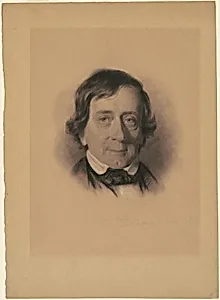
Medium
charcoal and graphite with white chalk on wove paper
Dimensions
image (irregular): 22.86 × 22.86 cm (9 × 9 in.) sheet: 53.02 × 38.1 cm (20 7/8 × 15 in.)
Classification
Drawing
Department
CG-W
Museum
National Gallery of Art, Washington, D.C.
Credit
Corcoran Collection (Museum Purchase)
Accession Number
2015.19.748
Rights
Public Domain
Art Historical Context
Eastman Johnson's *Richard Peters* (c. 1842) is an intimate portrait drawing that captures the early promise of one of America's foremost 19th-century realist artists. At just 18 years old, Johnson this work during his formative years in Maine and Massachusetts, honing his skills as a draftsman before gaining fame for luminous genre scenes and portraits of everyday life. The subject, Richard Peters, directly at the viewer with quiet intensity, evoking the era's interest in personal likenesses amid a growing American middle class. Rendered in charcoal and graphite heightened with white chalk on wove paper, the drawing showcases Johnson's masterful command of mixed media. Charcoal provides rich tonal depth and expressive modeling, while graphite adds precise lines for facial details, and white chalk highlights lend a sculptural luminosity—techniques rooted in 19th-century academic training and European influences Johnson would later explore abroad. The irregular 9 x 9-inch image on a larger sheet suggests a study or preparatory sketch, emphasizing spontaneity and direct observation. Acquired through the Corcoran Collection (Museum Purchase) and now housed in the National Gallery of Art's Department of Drawings, this piece highlights Johnson's transition from lithography apprentice to celebrated painter. It offers a window into antebellum America, where such portraits preserved identity and status, blending technical virtuosity with emotional resonance for modern viewers.
About the Artist
Eastman Johnson · 1824–1906
Eastman Johnson (1824–1906) was an American painter known as "the American Rembrandt" for his richly toned genre paintings and portraits that constitute one of the most important visual records of nineteenth-century American life. Born in Lovell, Maine, he trained in Düsseldorf, The Hague — where he studied the Dutch Old Masters extensively — and Paris before returning to the United States. Johns...