
Riderless Horse
n.d.
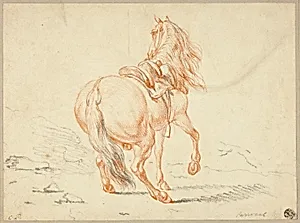
Medium
Lithograph in orange with graphite additions on cream laid paper, laid down on tan wove paper
Dimensions
Sheet: 20.2 × 27.3 cm (8 × 10 3/4 in.); Secondary support: 33.1 × 43.4 cm (13 1/16 × 17 1/8 in.)
Classification
lithograph
Department
Prints and Drawings
Museum
Art Institute of Chicago
Accession Number
81354
Rights
Public Domain
Art Historical Context
Behold the striking *Riderless Horse* Charles Parrocel, captivating lithograph in vibrant orange ink enhanced with delicate graphite additions on cream laid paper. Housed in the Art Institute of Chicago's and Drawings Department, this undated work measures a modest 20.2 × 27.3 cm, laid down on tan wove for preservation. Parrocel (1688–1752), a French artist from a dynasty of painters, was renowned for his energetic depictions of horses and battle scenes, blending Baroque dynamism with keen observation of equine anatomy. Lithography, a 19th-century printmaking technique invented decades after Parrocel's death, allowed this image—likely reproducing one of his original paintings or drawings—to reach wider audiences. The unusual orange tone evokes drama, perhaps a battlefield glow at dusk, while graphite heightens details like the horse's taut muscles and flowing mane, showcasing the medium's versatility for texture and depth. This piece highlights Parrocel's mastery of movement, capturing the horse's noble solitude amid implied chaos—a poignant symbol of war's toll. For visitors, it offers a window into 18th-century equestrian art, bridging historical painting traditions with innovative print reproduction.
About the Artist
Charles Parrocel · 1688–1752
Known for his paintings of battles and hunts. He also painted a number of equestrian portraits, including that of Louis XV in 1724. Comment on works: Landscapes