
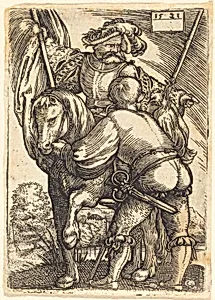
Riding Standard Bearer and Foot Soldier
1521
Medium
engraving
Dimensions
plate: 6 × 4.2 cm (2 3/8 × 1 5/8 in.) sheet: 6.2 × 4.4 cm (2 7/16 × 1 3/4 in.)
Classification
Department
CG-E
Museum
National Gallery of Art, Washington, D.C.
Credit
Rosenwald Collection
Accession Number
1943.3.873
Rights
Public Domain
Art Historical Context
**Riding Standard Bearer and Foot Soldier** (1521) is exquisite engraving by Barthel Be, a leading figure among the German "Little Masters of the Northern Renaissance. This tiny plate, measuring just 6 × 4.2 cm, captures a mounted standard bearer and a foot soldier in dynamic poses, likely evoking the military life of early 16th-century Europe. Beham, from Nuremberg, was renowned for his secular genre scenes and precise craftsmanship, often depicting everyday soldiers or peasants with remarkable detail. Engraving as a medium allowed Beham to achieve intricate lines and textures on copper plates, producing prints that rivaled paintings in finesse despite their miniature scale. Created amid the turbulent Holy Roman Empire—marked by Reformation stirrings and mercenary warfare—this work reflects the era's fascination with chivalric and foot soldier archetypes, such as the colorful Landsknechts. Housed in the National Gallery of Art's Rosenwald Collection (Department CG-E), this print exemplifies the democratic power of printmaking: affordable multiples spread artistic innovation widely. Visitors will appreciate how Beham packs narrative energy and technical virtuosity into a space smaller than a postcard, bridging art and history with elegant economy.
About the Artist
Barthel Beham · 1502–1540
Barthel Beham (1502–1540), a pivotal figure in the German Renaissance, was born in Nuremberg into a family of artists. The younger brother of the renowned engraver Hans Sebald Beham, he honed his craft under the tutelage of his elder sibling and the master Albrecht Dürer, absorbing the precise techniques of engraving and painting that defined Nuremberg's vibrant artistic scene. Emerging as a prodi...