
Rinaldo and Armida in Her Garden
1742/45
Medium
Oil on canvas
Dimensions
186.7 × 259.4 cm (73 1/2 × 102 1/8 in.); Framed: 194.3 × 270.5 × 7.9 cm (76 1/2 × 106 1/2 × 3 1/8 in.)
Classification
oil on canvas
Department
Painting and Sculpture of Europe
Museum
Art Institute of Chicago
Accession Number
16485
Rights
Public Domain
About this artwork
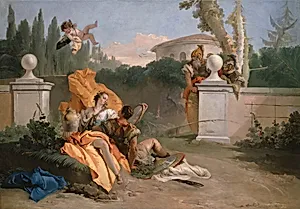
In this second of the four large paintings from Giovanni Battista Tiepolo’s sequence illustrating the story of the crusader Rinaldo and the sorceress Armida, Armida has abducted Rinaldo and carried him away to her magical garden. She looks into a magic mirror while the knight sits enthralled, gazing into her eyes, his sword and shield cast aside. Meanwhile, Rinaldo’s two companions, Carlo and Ubaldo, appear at the garden gate to persuade him to return to their quest to seize control of Jerusalem...
Art Historical Context
Step into the enchanting world of Giovanni Battista Tolo's *Rinaldo and Armida Her Garden* (1742/45), a masterful oil on canvas measuring nearly 7 by 8 ½ feet, now housed in the Art Institute of Chicago's Department of Painting and Sculpture of Europe. This grand narrative draws from Torquato T's 16th-century epic *Germe Liberata*, depicting the Christian knight Rinaldo ensnared by the seductive sorceress Armida amid her lush, magical garden. Tiepolo captures the moment of tender enchantment, where love battles duty, blending myth with human emotion. A pinnacle of Venetian Rococo, Tiepolo's style shines through in his exuberant brushwork, swirling compositions, and luminous play of light that bathes the figures in ethereal glow. Created during his peak career in Venice—before triumphs in Spain and Germany—this work exemplifies his fresco-like illusionism adapted to canvas, with vibrant colors and dynamic poses evoking theatrical drama. Its cultural resonance lies in the 18th-century fascination with operatic tales of passion and redemption, making it a visual symphony for Enlightenment audiences. Visitors will marvel at how Tiepolo transforms literature into a vivid, immersive spectacle, inviting reflection on love's intoxicating power.
About the Artist
Giovanni Battista Tiepolo · 1696–1770
Giovanni Battista Tiepolo (1696-1770) stands as the greatest decorative painter of eighteenth-century Europe, a Venetian master whose luminous frescoes and dynamic compositions defined the Rococo era's aesthetic zenith. Born in Venice on March 5, 1696, to a modest shipping merchant family, Tiepolo's extraordinary talent transcended his humble origins to establish him as the most sought-after artis...