
Ring
Unknown Artist
late 18th–early 19th century
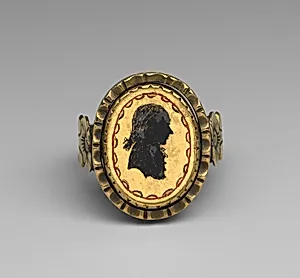
Medium
Gold (?)
Dimensions
Height: 15/16 in. (2.4 cm)
Classification
Jewelry
Culture
Austrian, Vienna
Department
European Sculpture and Decorative Arts
Museum
Metropolitan Museum of Art, New York, NY
Credit
Bequest of Zita Spiss, 1991
Accession Number
1993.3.13
Rights
Public Domain
Tags
Art Historical Context
This delicate gold ring, crafted in Vienna during the late 18 to early 19th century, exemplifies the exquisite jewelry traditions of the Austrian Empire. Measuring just 15/16 (2.4 cm) in height, it belongs to the Metropolitan Museum of Art's European Sculpture and Decorative Arts, gifted through the bequest of Zita Spiss in 1991. Its classification as jewelry highlights Vienna's renown as a hub for finely wrought personal adornments, often blending technical mastery with symbolic portraiture. The ring features profiles of women, emperors, and men—likely enameled or engraved cameos capturing imperial figures from the Habsburg era. This period, marked by the Napoleonic Wars and the transition from Holy Roman Emperor Francis II to Francis I of Austria, saw such pieces as intimate tokens of loyalty, mourning, or commemoration. Worn close to the body, these rings served not only as fashion but as subtle emblems of political and familial devotion. As a cultural artifact, it reflects the opulence of Viennese goldsmithing, where miniaturist techniques allowed for intricate storytelling in precious metals. Though the artist remains unknown, the ring's survival offers a tangible link to an era of grandeur and upheaval, inviting visitors to ponder the personal stories etched in its tiny profiles.