
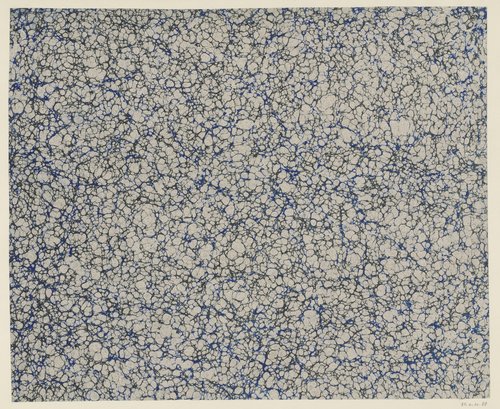
Ringkiezelmarmer in grijs
1700 - 1850
Medium
shell marbled paper
Dimensions
447; 366
Rights
Public Domain
About this artwork
collector's mark: Lugt 2760
Art Historical Context
Welcome to this delicate example of 18th- to early 19th-century decorative arts: *Ringkiezelmarmer in grijs* ("Ring Pebble Marble in Gray"), an anonymous sheet of shell marbled paper measuring 366 × 447 mm. Created between 1700 and 1850, likely in the Netherlands given the Dutch title, this piece showcases a specialized marbling technique where pigments were floated on a viscous bath—often thickened with carrageenan or size—and manipulated to form intricate, stone-like patterns resembling pebbles encircled in fluid grays. The "shell" method, using shellac or similar agents, produced shimmering, iridescent effects that mimicked polished marble or agate, making it prized for its hypnotic depth. Marbled paper flourished in Europe during this period as both an artistic craft and practical material for bookbinding, endpapers, and stationery. Dutch marblers were renowned for their precise, nature-inspired designs like this ring-pebble motif, which evoked the rippling surfaces of rivers or geological wonders. Though anonymous, the work bears the collector's mark Lugt 2760, linking it to a distinguished provenance and highlighting its value among connoisseurs who preserved these ephemeral beauties. This sheet invites us to marvel at the blend of chemistry, skill, and whimsy in pre-industrial artistry—a testament to how everyday paper could become a miniature landscape of endless variation.
About the Artist
anonymous
In the vast tapestry of art history, "Anonymous" stands not as a singular individual but as a collective designation for countless unidentified creators whose works have endured across millennia. These artists, spanning prehistoric cave painters to medieval illuminators and folk craftsmen, produced the foundational layers of human visual culture. Prior to the Renaissance, when individual fame emer...