
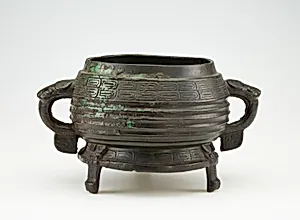
Ritual Vessel (Guei)
1100-900 B.C.
Medium
Decorative Arts
Classification
Decorative Arts
Department
Smithsonian Collection
Museum
Smithsonian American Art Museum
Credit
Smithsonian American Art Museum, Gift of John Gellatly
Accession Number
1929.8.332
Rights
Public Domain
Art Historical Context
### Ritual Vessel (GueiStep back 3,000 years to China during the Western Zhou dynasty (c. 1100–900 B.C.), where this striking Ritual Vessel, known as a *gui*, served as a sacred object in ceremonial life. As a type of bronze food vessel, it was used to hold offerings of grain or rice during rituals honoring ancestors—a cornerstone of Zhou society. These vessels were not mere utensils but powerful symbols of social status and spiritual devotion, often buried in elite tombs to accompany the deceased into the afterlife. Crafted by an unidentified artisan, the *gui* exemplifies the era's mastery of bronze casting techniques, likely employing the intricate piece-mold method to create its characteristic three-legged form and ritual-ready shape. While specific decorations aren't detailed here, such vessels typically featured bold motifs evoking mythical creatures, blending artistry with cosmology. Its presence in the Smithsonian American Art Museum's Decorative Arts collection, a gift from John Gellatly, highlights its enduring value as a window into early Chinese civilization's reverence for ritual and hierarchy. Today, this artifact invites us to ponder the timeless human impulse to connect with the divine through crafted beauty. (198 words)
About the Artist
Unidentified ( ) · –