
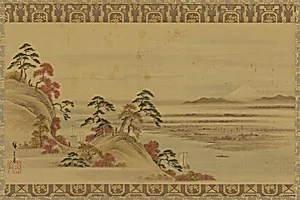
River landscape: red foliage and Mount Fuji
mid 19th century
Classification
Painting
Department
Smithsonian Collection
Museum
Smithsonian American Art Museum
Credit
Gift of Charles Lang Freer
Accession Number
F1905.234
Rights
Public Domain
Tags
About this artwork
To 1905
Art Historical Context
This enchanting *River landscape: red foliage Mount Fuji* by Utagawa Hirosh II (1826–1869) captures the poetic beauty of Japan's natural world during the Edo period (161–1868). As a successor in the renowned Utagawa school of ukiyo-e—following his master Hiroshige I—Hiroshige II specialized in evocative landscapes that blend human presence with the grandeur of nature. Created in the mid-19th century this kakemono (hanging scroll painting) likely served as a decorative focal point in a traditional Japanese home or tea room, unrolled for seasonal appreciation. The composition highlights a serene river winding through vibrant red autumn foliage, with the majestic Mount Fuji rising in the distance—a sacred symbol of Japan often depicted in art to evoke impermanence and harmony with nature. The bold colors and fluid lines reflect ukiyo-e's emphasis on atmospheric perspective and seasonal *mono no aware* (the pathos of things), inviting viewers to contemplate fleeting beauty. Though the exact medium is unknown, its style echoes the woodblock print tradition while showcasing Hiroshige II's painterly finesse. A cherished piece from the Charles Lang Freer collection, gifted to the Smithsonian American Art Museum, it bridges Japan's artistic heritage with American appreciation for Eastern aesthetics. Perfect for savoring with a cup of tea!