
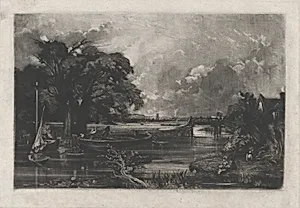
River Stour
Medium
Mezzotint; proof before published state
Dimensions
Image: 5 11/16 × 8 11/16 in. (14.4 × 22.1 cm) Plate: 6 15/16 × 9 7/8 in. (17.6 × 25.1 cm) Sheet: 8 7/8 × 11 15/16 in. (22.5 × 30.3 cm)
Classification
Prints
Department
Drawings and Prints
Museum
Metropolitan Museum of Art, New York, NY
Credit
Harris Brisbane Dick Fund, 1925
Accession Number
25.51.13
Rights
Public Domain
Tags
Art Historical Context
Visitors to the Metropolitan Museum of Art's Drawings and Prints department will delight in *River Stour* (1830), a mezzotint proof crafted by engraver David Lucas after an original composition by John Constable. This intimate print (image: 5 11/16 × 8 11/16 in.) captures the tranquil Suffolk countryside along the River Stour—Constable's beloved "Stour" region—with boats gliding on the water and human figures dotting the scene, ev the everyday harmony of rural England. Constable, a pioneer of Romantic landscape painting, championed naturalistic light and atmosphere over idealized scenes, influencing generations from the Impressionists onward. In the 1830s, he partnered with Lucas on *English Landscapes*, a series of mezzotints that translated his oil sketches into richly toned prints. Mezzotint, prized for its velvety blacks and subtle gradations, allowed these works to rival paintings in depth, making Constable's vision accessible to a wider audience through affordable reproductions. As a "proof before published state," this rare impression reveals the meticulous refinement process, with potential adjustments still visible. Acquired via the Harris Brisbane Dick Fund in 1925, it underscores the print's role in democratizing art during the 19th century, bridging fine painting and popular culture.
About the Artist
David Lucas|John Constable · 1802–1881
**David Lucas (1802–1881)** David Lucas was born in 1802 in Geddington Chase, Northamptonshire, the son of a farmer.) A chance encounter in 1820 led him to become a pupil of the renowned engraver Samuel William Reynolds, under whom he apprenticed in London until 1827, mastering the art of mezzotint engraving.) By 1827, Lucas had published his first mezzotints, showcasing his precocious talent for...