
五代 傳董元 溪岸圖 軸|Riverbank
Medium
Hanging scroll; ink and color on silk
Dimensions
Image: 86 3/4 × 43 in. (220.3 × 109.2 cm) Overall with mounting: 11 ft. 1/2 in. × 48 in. (336.6 × 121.9 cm) Overall with knobs: 11 ft. 1/2 in. × 53 in. (336.6 × 134.6 cm)
Classification
Paintings
Culture & Period
China · Southern Tang dynasty (937–76)
Department
Asian Art
Museum
Metropolitan Museum of Art, New York, NY
Credit
Ex coll.: C. C. Wang Family, Gift of Oscar L. Tang Family, in memory of Douglas Dillon, 2016
Accession Number
2016.750
Rights
Public Domain
Tags
About this artwork
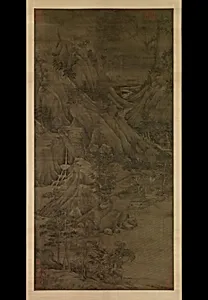
This monumental landscape depicts a riverbank scene, attributed to Dong Yuan and dated to the period of the Southern Tang dynasty between 937 and 976. The hanging scroll presents a vertical composition showing mountains, rivers, trees, and small human figures integrated into a cohesive natural world. The painting exemplifies Dong Yuan's innovative style, with its absence of hard contour lines and use of subtle ink washes and soft-rubbed texture strokes to describe the distinctive rounded hills a...
Art Historical Context
This monumental hanging scroll, *Riverbank*, attributed to the renowned Southern Tang dynasty painter Dong Yuanactive mid-10th century), captures the serene harmony of nature in a towering vertical composition. Dating to the Southern Tang period (937–976), it depicts a misty riverbank alive with rounded hills, flowing waters, ancient trees, and tiny human figures dwarfed by the landscape. At over 220 cm tall—the tallest surviving early Chinese landscape painting—it invites viewers to ascend visually from the foreground shallows to distant mist-shrouded peaks,oking the spiritual essence of southeastern China's terrain. Dong Yuan, a court painter and official in Nanjing (then Jinling), revolutionized landscape art alongside his pupil Juran, pioneering the "Southern style." Eschewing rigid outlines, he employed subtle ink washes, soft-rubbed texture strokes, and delicate color on silk to suggest atmospheric depth and organic forms, prioritizing mood and nature's vitality over literal topography. Though some scholars debate the attribution, favoring a later date, its innovative techniques profoundly shaped Chinese painting for centuries. Housed in the Metropolitan Museum of Art's Asian Art collection, this gift from the Oscar L. Tang Family honors the timeless allure of China's golden age of landscape mastery, where mountains and rivers whisper tales of impermanence and wonder.