
Road Through a Village
Medium
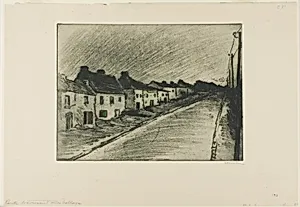
Soft ground etching from two zinc plates in 3 colors (dark green, bright green and brown) on ivory wove paper
Dimensions
Image/plate: 21.1 × 28.7 cm (8 5/16 × 11 5/16 in.); Sheet: 31.3 × 45.2 cm (12 3/8 × 17 13/16 in.)
Classification
etching
Department
Prints and Drawings
Museum
Art Institute of Chicago
Accession Number
49690
Rights
Public Domain
Art Historical Context
Théophile-Alexandre Steinlen's *Road Through a Village*1902) captures the serene charm of rural French life at the turn of the 20th century. A master of Belle Époque illustration and poster art, Steinlen—born in Switzerland and based in Paris—was renowned for his empathetic depictions of everyday people, from cabaret dancers to urban workers. This etching shifts to pastoral scenes, evoking the quiet paths and lush greenery of a countryside village, rendered in earthy tones that highlight his versatility beyond his famous cat motifs and social commentary. Crafted as a soft ground etching from two zinc plates in three colors—dark green, bright green, and brown—on ivory wove paper, the work showcases innovative printmaking techniques. Soft ground etching allows for subtle textures mimicking pencil or crayon marks, while the multi-plate color process, rare for etchings at the time, achieves vibrant, layered depth (image: 21.1 × 28.7 cm). This method reflects the era's experimentation in reproductive prints, bridging fine art and accessibility. Housed in the Art Institute of Chicago's Prints and Drawings department, *Road Through a Village* exemplifies Steinlen's skill in blending realism with poetic atmosphere, offering visitors a window into pre-World War I nostalgia for vanishing rural traditions amid France's rapid modernization.
About the Artist
Théophile-Alexandre Pierre Steinlen · 1859–1923
Théophile Alexandre Steinlen, born on November 10, 1859, in Lausanne, Switzerland, grew up in an environment steeped in artistic influence, with his grandfather serving as a drawing teacher in nearby Vevey. He studied literature at the University of Lausanne before working as a designer trainee in a Mulhouse textile mill. In his early twenties, around 1881, Steinlen married Émilie Mey, and the cou...