
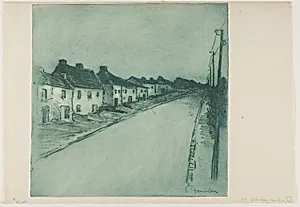
Road Through a Village
Medium
Soft ground etching from the first of two zinc plates in blue-green on ivory laid paper
Dimensions
Image/plate: 29.4 × 29.8 cm (11 5/8 × 11 3/4 in.); Sheet: 30.6 × 44.6 cm (12 1/16 × 17 9/16 in.)
Classification
etching
Department
Prints and Drawings
Museum
Art Institute of Chicago
Accession Number
49581
Rights
Public Domain
Art Historical Context
Théophile-Alex Steinlen's *Road Through a Village (1902) captures a serene rural moment through the delicate medium of soft ground etching A Swiss-born artist who made home in Paris's vibrant Montre, Steinlen was a master printmaking, renowned for his Art Nouveau posters,, and social realist depictions of everyday life. This work, the first of two zinc printed in evocative blue-green on ivory laid paper, exemplifies his skill in translating textured scenes onto paper with subtle tonal variations. Soft ground etching, a technique Steinlen favored, allowed for soft, velvety lines that mimic pencil or chalk drawings, lending a sense of immediacy and intimacy to the composition. Measuring nearly 12 inches square, the image evokes the quiet paths of French countryside villages during the Belle Époque, a time when rapid urbanization contrasted with nostalgic rural idylls. Zinc plates, less common than copper for etchings, contributed to the print's crisp yet atmospheric quality. Housed in the Art Institute of Chicago's Prints and Drawings collection, this piece highlights Steinlen's versatility beyond his famous cabaret posters, offering visitors a glimpse into his tender observation of humble landscapes and the artistry of early 20th-century print innovation.
About the Artist
Théophile-Alexandre Pierre Steinlen · 1859–1923
Théophile Alexandre Steinlen, born on November 10, 1859, in Lausanne, Switzerland, grew up in an environment steeped in artistic influence, with his grandfather serving as a drawing teacher in nearby Vevey. He studied literature at the University of Lausanne before working as a designer trainee in a Mulhouse textile mill. In his early twenties, around 1881, Steinlen married Émilie Mey, and the cou...