
Rocaille Ornament Designs
mid- 18th century
Classification
Department
Smithsonian Collection
Museum
Smithsonian American Art Museum
Credit
Purchased for the Museum by the Advisory Council
Accession Number
1921-6-317-19
Rights
Public Domain
About this artwork
Research in Progress
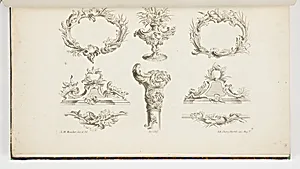
Art Historical Context
Georg Michael Roscher, a German engraver active from 1700 to 1775, created *Rocaille Ornament Designs* in the mid-18th century, the exuberant spirit of the Rococo style. Rocaille, meaning "rockwork" or "shellwork," epitomized this movement's playful asymmetry, with swirling shells, foliage, and fantastical curves that adorned everything from furniture to architecture. As a print, Roscher work served as a pattern book, allowing artisans across Europe to replicate these intricate motifs in silverwork, interiors, and decorative arts. These designs reflect the Rococo era's shift from Baroque grandeur toward lighter, more intimate elegance, flourishing in German courts and influencing international tastes. Prints like this were revolutionary tools for disseminating fashion in design, bridging workshops from Paris to Dresden and even reaching colonial America, where such ornamentation inspired early cabinetmakers. Housed in the Smithsonian American Art Museum's collection—purchased by the Advisory Council—this piece awaits further research, underscoring its enduring value in tracing ornamental history. Visitors can appreciate how Roscher's delicate lines evoke the era's whimsical luxury, inviting us to imagine rocaille gracing a lavish salon.