
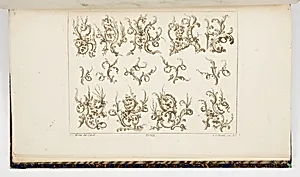
Rocaille Rinceaux Designs
mid- 18th century
Medium
Classification
Department
Smithsonian Collection
Museum
Smithsonian American Art Museum
Credit
Purchased for the Museum by the Advisory Council
Accession Number
1921-6-317-61
Rights
Public Domain
About this artwork
Research in Progress
Art Historical Context
**Rocaille Rince Designs** by Georg Leopold Hertel, German artist active around 1780, captures theant spirit of mid-18th-century Rococo ornamentation. Created as a print during the height of this lavish style—popular across Europe from the 1730s onward—this work showcases *rocaille* motifs, inspired by seashells, rocks, and asymmetrical curves, intertwined with *rinceaux the flowing, vine-like scrolls that defined decorative elegance. Hertel's design reflects the Rococo era's shift from Baroque grandeur toward playful, intimate embellishments, often adorning furniture, architecture, and silverwork. As a print, this piece served a practical purpose in the dissemination of artistic ideas. Prints like Hertel's were invaluable tools for artisans, enabling the replication of intricate patterns far beyond the artist's studio. Produced in Germany amid a flourishing printmaking tradition, it highlights how ornamental designs traveled through trade and collections, influencing tastes from royal courts to bourgeois homes. Housed in the Smithsonian American Art Museum, acquired through the Advisory Council, this artwork bridges European refinement with emerging American decorative arts. Though research continues, it invites us to appreciate Rococo's whimsical legacy—elegant scrolls that whisper of opulent salons and the artistry of pattern-making in a pre-industrial age.