
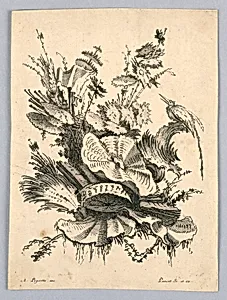
Rocaille Vignette
mid- 18th–late 18th century
Medium
Classification
Department
Smithsonian Collection
Museum
Smithsonian American Art Museum
Credit
Gift of Eleanor and Sarah Hewitt
Accession Number
1931-94-688
Rights
Public Domain
About this artwork
Research in Progress
Art Historical Context
**Rocaille Vignette by Alexis PeyrotteFrench, 1699–1769) captures the exuberant spirit of mid- to late-18th-century Rococo design. Created as a print, this vignette—likely a small, ornate decorative motif—showcases Peyrotte's of *rocaille*, the signature Rococo style featuring asymmetrical scrolls, shells, and rock-like forms inspired by nature's fluidity. Peyrotte, a prolific Parisian artist and designer, produced such works to inspire luxury furnishings, wallpapers, and porcelain, reflecting the era's taste for playful elegance amid France's opulent Ancien Régime. As a print, the piece played a vital role in disseminating high-style decoration to artisans across Europe, bridging fine art and everyday luxury. Rococo, emerging around 1730 as a lighter successor to Baroque grandeur, emphasized interior whimsy over solemnity, perfectly suiting the intimate salons of the aristocracy. This example, now in the Smithsonian American Art Museum's collection (gift of Eleanor and Sarah Hewitt), highlights how prints preserved and popularized fleeting fashions. Though research continues, *Rocaille Vignette* invites us to appreciate Rococo's joyful intricacy—a frozen moment of 18th-century fantasy that still delights the eye today. (178 words)