
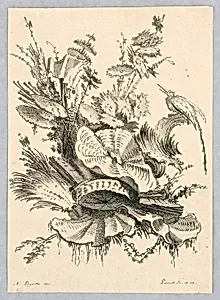
Chinoiserie Rocaille Vignette
mid- 18th–late 18th century
Classification
Department
Smithsonian Collection
Museum
Smithsonian American Art Museum
Credit
Gift of Eleanor and Sarah Hewitt
Accession Number
1931-94-689
Rights
Public Domain
About this artwork
Research in Progress
Art Historical Context
Alexis Peyrotte’s *Chinoiserie Rocaille Vignette* captures the playful spirit of mid-to-late eighteenth-century French design. Created during the height of the Rococo period, the print reflects Europe’s fascination with imagined Asian landscapes and motifs, blending delicate Chinese-inspired figures, pagodas, and exotic flora with the swirling shell-like forms known as rocaille. Peyrotte, a skilled ornamental designer, helped popularize this hybrid style that appeared on everything from wallpapers to porcelain. As a print, the work would have served as a model or pattern for craftsmen, allowing these lighthearted, asymmetrical compositions to circulate widely among artisans and collectors. Its presence in the Smithsonian American Art Museum, gifted by the Hewitt sisters, underscores how such decorative designs influenced both European and American tastes long after their creation. Though details of its exact medium remain under study, the vignette offers a charming window into the cultural exchange and decorative exuberance that defined Rococo art.