
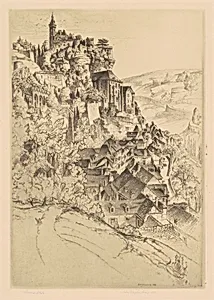
Rocamadour
1926-1927
Medium
etching in black on laid paper
Dimensions
plate: 34.93 × 24.45 cm (13 3/4 × 9 5/8 in.) sheet: 49.21 × 32.7 cm (19 3/8 × 12 7/8 in.)
Classification
Department
CG-W
Museum
National Gallery of Art, Washington, D.C.
Credit
Corcoran Collection (Bequest of Frank B. Bristow)
Accession Number
2015.19.1080
Rights
Public Domain
Art Historical Context
Nestled high on a cliffside in southwestern France, Rocamadour is a medieval pilgrimage site famed for its cascading chapels and dramatic perch overlooking the Alzou River. In this 1926-1927 etching, American artist John Taylor Arms masterfully captures its vertiginous architecture, evoking a sense of awe and spiritual mystery. Arms, a leading figure in early 20th-century American printmaking and president of the Society of American Graphic Artists, was renowned for his meticulous renderings of Gothic and Romanesque structures during his European travels. Executed in black ink on laid paper—a traditional support with visible chain lines that enhances the print's tactile quality—the work measures 34.93 × 24.45 cm on the plate. Etching allowed Arms to achieve extraordinary fine lines and tonal depth, rendering the stone textures, shadowed crevices, and soaring spires with precision and romantic intensity. This technique, rooted in the 15th-century tradition revitalized in the 19th century by artists like Whistler, underscores Arms' commitment to preserving architectural heritage through graphic art. Part of the Corcoran Collection at the National Gallery of Art, *Rocamadour* exemplifies the interwar fascination with Europe's ancient wonders amid modernism's rise. Visitors are invited to marvel at how Arms transforms a static view into a timeless tribute to human ingenuity and faith.
About the Artist
John Taylor Arms · 1887–1953
John Taylor Arms (1887–1953) was one of America's foremost etchers of the twentieth century, renowned for his meticulous renderings of Gothic architecture. Born in Washington, D.C., he initially pursued law at Princeton University before transferring to the Massachusetts Institute of Technology, where he earned a master's degree in architecture in 1912. He apprenticed as a draftsman and worked for...