
Rocking Chair
1935/1942
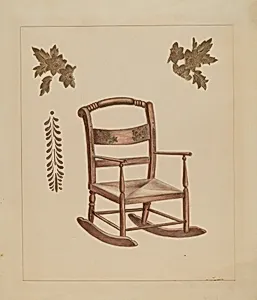
Medium
watercolor, colored pencil, gold ink, and graphiteon paper
Dimensions
overall: 27.6 x 23.9 cm (10 7/8 x 9 7/16 in.) Original IAD Object: none given
Classification
Index of American Design
Department
CG-W
Museum
National Gallery of Art, Washington, D.C.
Credit
Index of American Design
Accession Number
1943.8.4537
Rights
Public Domain
Art Historical Context
**Rocking Chair** by Charlotte Winter (1935/1942) is a captivating rendering from the Index of American Design, a landmark WPA Federal Art Project initiative during the Great Depression. between 1935 and 1942, this, colored pencil, gold, and graphite drawing on paper (27.6 x 23.9 cm) meticulously documents an everyday American artifact: the humble rocking chair. Winter, of many skilled artists employed by the project, captured its form with precision and vibrancy, highlighting the chair's graceful curves and sturdy construction in a style that blends technical accuracy with artistic flair. The Index of American Design aimed to preserve the nation's cultural heritage by recording folk art, crafts, and design objects through over 15,000 such detailed illustrations. Rocking chairs, iconic symbols of American domestic life and comfort since the 18th century, embodied vernacular ingenuity—often handmade by local craftsmen using native woods. Winter's use of gold ink adds a luminous touch, evoking the chair's polished surfaces and perhaps patina, while the mixed media allowed for nuanced textures and colors true to the original. Housed in the National Gallery of Art's collection, this work underscores the project's role in celebrating ordinary beauty amid economic hardship, reminding us of America's rich tradition of functional artistry. A testament to resilience and creativity, it invites visitors to appreciate the poetry in the prosaic.
About the Artist
Charlotte Winter · 1855–present
Charlotte Winter was an American artist who made her most lasting contribution during the late 1930s and early 1940s as a participant in the Index of American Design, a major New Deal program administered under the Works Progress Administration's Federal Art Project. The Index employed artists across the United States to document the nation's decorative arts heritage through meticulous watercolor ...