
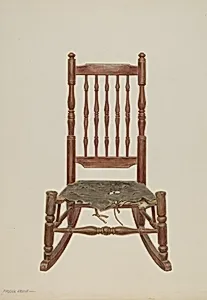
Rocking Chair with Rawhide Seat
c. 1938
Medium
watercolor, colored pencil, gouache and graphite on paper
Dimensions
overall: 35 cm (13 3/4 in.) Original IAD Object: 37 1/2"high; 18"wide. See data sheet for details.
Classification
Index of American Design
Department
CG-W
Museum
National Gallery of Art, Washington, D.C.
Credit
Index of American Design
Accession Number
1943.8.4463
Rights
Public Domain
Art Historical Context
Frank M. Keane's *Rocking Chair with Raw Seat* (c. 1938) is a meticulous rendering that captures the sturdy elegance of an everyday American artifact. Created as watercolor, colored pencil,ache, and graphite on paper, this 13¾-inch-high drawing depicts a classic rocking chair with a taut rawhide seat, evoking the rustic craftsmanship of early 20th-century American homes. The original chair measured 37½ inches high and 18 inches wide highlighting its practical scale for cozy domestic use. This artwork belongs to the Index of American Design, a landmark WPA Federal Art Project from the Great Depression era (1935–1942). Artists like Keane produced thousands of such detailed illustrations to document and celebrate the nation's folk art and decorative traditions, preserving cultural heritage amid economic hardship. Keane's precise techniques—layering translucent watercolors with opaque gouache and fine graphite lines—lend a lifelike quality, making the chair's woven rawhide and wooden rockers almost tangible. Symbolizing comfort and ingenuity, the rawhide seat nods to resourceful American design, possibly drawing from frontier or Southwestern influences where durable, natural materials prevailed. Displayed at the National Gallery of Art, this piece invites visitors to appreciate how ordinary objects embody our shared history.
About the Artist
Frank M. Keane · 1876–1941
Frank M. Keane was born on June 6, 1866, in San Francisco, California, where he received his artistic training at the School of Design. A longtime resident of the city at the turn of the century, he developed a versatile practice that included illustration work, such as designing bookmarks in an Arts and Crafts style for the prominent San Francisco publisher Paul Elder around 1905. His early outpu...