
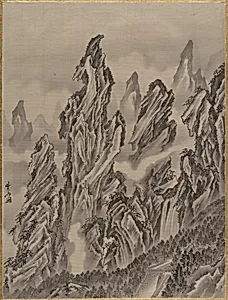
Rocky Landscape
ca. 1887
Medium
Album leaf; ink and color on silk
Dimensions
14 1/4 x 10 3/4 in. (36.2 x 27.3 cm)
Classification
Paintings
Culture & Period
Japan · Meiji period (1868–1912)
Department
Asian Art
Museum
Metropolitan Museum of Art, New York, NY
Credit
Charles Stewart Smith Collection, Gift of Mrs. Charles Stewart Smith, Charles Stewart Smith Jr., and Howard Caswell Smith, in memory of Charles Stewart Smith, 1914
Accession Number
14.76.61.12
Rights
Public Domain
Tags
Art Historical Context
Nestled within the dynamic Meiji period (1868–1912), when Japan rapidly modernized under Western influences, *Rocky Landscape* by Kawabe Kyōsai (1831–1889) stands as a testament to the artist's unwavering commitment to traditional Japanese painting Created around 1887 as an album leaf—intimate, collectible sheets often mounted in albums for private appreciation—this work measures a compact 14¼ × 10¾ inches and employs ink and light color on silk, evoking the rugged majesty of mountains through bold, expressive brushstrokes. Kyōsai, a prolific and eccentric master nicknamed "the painting demon" for his prodigious output and wild spirit, blended ukiyo-e traditions with his signature vitality. Though famed for satirical caricatures and fantastical scenes, his landscapes like this one capture nature's raw power with minimalist composition: jagged rocks and soaring peaks rendered in fluid ink washes and subtle pigments, highlighting silk's luminous texture. This piece reflects Meiji-era tensions between tradition and change, as Kyōsai championed indigenous techniques amid Japan's global opening. Housed in the Metropolitan Museum of Art's Asian Art collection since 1914, *Rocky Landscape* invites visitors to ponder the enduring allure of Japan's natural sublime, where every crag whispers resilience and timeless beauty.
About the Artist
Kawanabe Kyōsai 河鍋暁斎 (Japanese) · 1831 –1889
Japanese, 1831–1889