
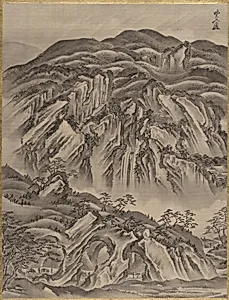
Rocky Landscape
ca. 1887
Medium
Album leaf; ink and color on silk
Dimensions
14 1/4 x 10 7/8 in. (36.2 x 27.6 cm)
Classification
Paintings
Culture & Period
Japan · Meiji period (1868–1912)
Department
Asian Art
Museum
Metropolitan Museum of Art, New York, NY
Credit
Charles Stewart Smith Collection, Gift of Mrs. Charles Stewart Smith, Charles Stewart Smith Jr., and Howard Caswell Smith, in memory of Charles Stewart Smith, 1914
Accession Number
14.76.61.22
Rights
Public Domain
Tags
Art Historical Context
Kawanabe Kyōsai’s *Rocky Landscape*, created around 1887, offers a serene view of towering mountains rendered with delicate precision. Painted during Japan’s Meiji period (1868–1912), a time of rapid modernization and cultural transition, the work reflects the enduring appeal of traditional landscape themes even as the nation embraced new influences from the West. Kyōsai, active in this transformative era, captured the rugged beauty of nature in a compact format that invites quiet contemplation. Executed as an album leaf in ink and color on silk, the painting highlights the artist’s mastery of subtle washes and fine brushwork. Silk’s luminous surface allows colors to glow softly while preserving intricate details of rocky forms and misty peaks. This intimate medium, typically bound into albums for personal enjoyment, underscores the refined aesthetic traditions of Japanese art, where viewers could appreciate the scene up close, perhaps turning pages like a visual journey through the mountains. Now part of the Metropolitan Museum of Art’s Asian Art collection, *Rocky Landscape* exemplifies how Meiji-era artists maintained deep connections to Japan’s natural and artistic heritage. Its focus on mountains evokes timeless themes of harmony with nature, offering today’s visitors a glimpse into a pivotal moment when tradition and change coexisted in Japanese painting.
About the Artist
Kawanabe Kyōsai 河鍋暁斎 (Japanese) · 1831 –1889
Japanese, 1831–1889