
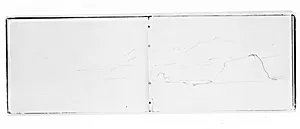
Rocky Landscape (Cape Flattery) (from Sketchbook X)
Medium
Graphite on off-white wove paper
Dimensions
5 x 7 1/2 in. (12.7 x 19.1 cm)
Classification
Drawing
Culture
American
Department
The American Wing
Museum
Metropolitan Museum of Art, New York, NY
Credit
Purchase, Gifts in memory of Stephen D. Rubin, 1992
Accession Number
1992.2.2b verso
Rights
Public Domain
Tags
Art Historical Context
William Trost Richards, a 19th-century American artist associated with the Hudson River School, captured the rugged beauty of Cape Flattery in this intimate graphite sketch from his Sketchbook X, dated 1885. Cape Flattery, located at the northwestern tip of Washington state's Olympic Peninsula, offered Richards a dramatic coastal vista of jagged rocks, crashing waves, and untamed wilderness—prime subjects for his lifelong passion for precise nature studies. By the 1880s, Richards honed his reputation for meticulous landscapes, often traveling to remote American sites to document the sublime power of the natural world. Rendered in graphite on off-white wove paper, this small-scale work (5 x 7½ inches) exemplifies the artist's preparatory sketches, where fine pencil lines and subtle shading build texture and depth. Wove paper, with its smooth, even surface, was ideal for such detailed drawings, allowing Richards to layer tones that evoke the rocky terrain's craggy forms and atmospheric light. These sketches were foundational to his larger watercolors and oils, showcasing his Pre-Raphaelite-inspired fidelity to nature. Housed in The Metropolitan Museum of Art's American Wing, *Rocky Landscape (Cape Flattery)* highlights Richards' role in American landscape art, bridging Romanticism and Realism. It invites visitors to appreciate the quiet intensity of an artist's on-site observation, preserving a fleeting moment of the Pacific Northwest's wild coastline.
About the Artist
William Trost Richards · 1833–1905
William Trost Richards (1833–1905) was a prominent American landscape and marine painter born in Philadelphia, where he attended Central High School before beginning his artistic training. Between 1850 and 1855, he studied part-time under the German-born Hudson River School artist Paul Weber while working as a designer and illustrator of ornamental metalwork. He exhibited his first works at the Pe...