
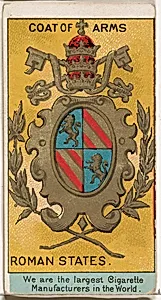
Roman States, from the Rulers, Flags, and Coats of Arms series (N126-2) issued by W. Duke, Sons & Co.
Medium
Commercial color lithograph
Dimensions
Sheet: 2 3/4 × 4 1/4 in. (7 × 10.8 cm) Sheet (folded): 2 3/4 × 1 7/16 in. (7 × 3.6 cm)
Classification
Prints|Ephemera
Department
Drawings and Prints
Museum
Metropolitan Museum of Art, New York, NY
Credit
The Jefferson R. Burdick Collection, Gift of Jefferson R. Burdick
Accession Number
63.350.206.126.90
Rights
Public Domain
Tags
About this artwork
This Roman States, from the Rulers, Flags, and Coats of Arms series (N126-2) issued by W. Duke, Sons & Co. by W. Duke, Sons & Co. dating to 1888 exemplifies the period. Created in commercial color lithograph, the work demonstrates technical mastery of materials and processes characteristic of the era. As part of the Metropolitan Museum of Art's Drawings and Prints, this piece contributes to our understanding of historical artistic production. Prints from this period served diverse functions—arti...
Art Historical Context
Step into the vibrant world of 19th-century ephemera with *Roman States*, a gem from the *Rulers, Flags, Coats of Arms* (N126-2), issued by the American tobacco giant W. Duke, Sons & Co. in 1888. This petite commercial color lithograph, just 2¾ × 4¼ inches (and foldable to an even tinier 2¾ × 1⅜ inches), captures the coat of arms of the Roman—likely referencing the historic Papal States or Italian regions tied to papal authority. Produced as collectible inserts for Duke's cigarette packs, it was part of a popular trend where everyday consumers traded these cards like modern trading cards, blending education with promotion. Chromolithography, the era's breakthrough in mass color printing, shines here through its bold hues and precise details, making heraldry accessible to the masses. No longer confined to elite manuscripts, such symbols of power and identity reached ordinary pockets, democratizing history and fostering a visual literacy amid America's Gilded Age boom. Duke's innovative marketing fueled this craze, with series like this educating smokers on global emblems while boosting sales. Today, housed in the Metropolitan Museum of Art's Jefferson R. Burdick Collection, this unassuming print reveals how commercial ingenuity reshaped popular culture, turning tobacco tins into tiny museums of the world. A delightful snapshot of Victorian collecting fever!
About the Artist
W. Duke, Sons & Co. · 1870–1920
**W. Duke, Sons & Co.: Pioneers of Chromolithographic Trade Card Art** W. Duke, Sons & Co., an American tobacco manufacturer, emerged from the entrepreneurial vision of Washington Duke (1820–1905) and his sons in Durham, North Carolina. After the Civil War, Washington abandoned farming in 1874 to join his eldest son, Brodie L. Duke, in the burgeoning tobacco trade, establishing a factory that for...