
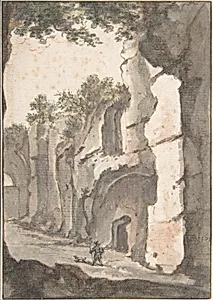
Roman View
early 17th century
Medium
Watercolor over red chalk; framing lines in pen and black ink
Dimensions
Overall: 5 7/8 x 4 3/16 in. (15 x 10.6 cm)
Classification
Drawings
Department
Drawings and Prints
Museum
Metropolitan Museum of Art, New York, NY
Credit
Rogers Fund, 1965
Accession Number
65.136.2
Rights
Public Domain
Tags
Art Historical Context
Bartholomeus Breenbergh, a Dutch artist active during the early seventeenth century, created this intimate drawing during his formative travels in Italy. Known for his Italianate landscapes, Breenbergh specialized in scenes that blended the grandeur of ancient Roman ruins with the quiet poetry of the surrounding countryside. "Roman View" captures this fascination, presenting crumbling classical architecture framed by lush trees and accented by small human figures that suggest daily life continuing amid the remnants of empire. Executed in watercolor over red chalk with delicate pen-and-ink framing lines, the drawing exemplifies the artist’s refined technique for on-site studies. The translucent washes allow the red chalk underdrawing to lend warmth and depth, while the modest scale—just under six inches high—invites close viewing, as if the visitor is sharing Breenbergh’s vantage point. Such works were prized by collectors for their freshness and served as both travel souvenirs and sources for later studio paintings. Today housed in the Metropolitan Museum’s Department of Drawings and Prints, this sheet reflects the broader Northern European interest in classical antiquity during the Baroque era. Breenbergh’s sensitive rendering of light, texture, and atmosphere helped shape the Dutch tradition of ideal landscape, bridging observation and imagination for generations of viewers.
About the Artist
Bartholomeus Breenbergh · 1598–1657
Probably was apprenticed in Amsterdam. He was one of the early Dutch italianates, that is, northern artists who travelled to Italy in the 1620s and were inspired by southern landscapes. On his return, he settled in Amsterdam and his landscapes were developed as more severe and monumental, often with historical subjects; strongly influenced by the Pre-Rembrandtists. Comment on works: Landscapes; Ru...