
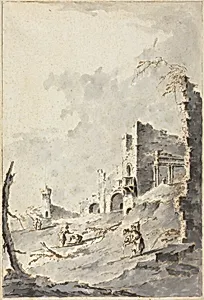
Capriccio of Classical Ruins with a Fortress
1751 to 1775
Medium
pen and brown ink with gray wash on laid paper
Dimensions
overall (approximate): 52.1 x 36.3 cm (20 1/2 x 14 5/16 in.)
Classification
Drawing
Department
CG-E
Museum
National Gallery of Art, Washington, D.C.
Credit
Gift of Howard Sturges
Accession Number
1956.9.19
Rights
Public Domain
Art Historical Context
Giacomo Guardi’s *Capriccio of Classical Ruins with a Fortress* invites viewers into an imagined landscape where ancient columns, crumbling arches, and a sturdy fortress coexist in harmonious decay. Created between 1751 and 1775, the drawing reflects the eighteenth-century fascination with classical antiquity that captivated European travelers on the Grand Tour. Guardi, working in the Venetian tradition, blends real architectural motifs with fantasy, evoking a romantic nostalgia for a lost past while showcasing Venice’s own artistic heritage of inventive view-painting. Executed in pen and brown ink with gray wash on laid paper, the work demonstrates the expressive potential of this medium. Delicate linework defines the intricate stonework and distant hills, while subtle washes create atmospheric depth and dramatic contrasts of light and shadow. Measuring roughly 52 by 36 centimeters, the sheet’s scale allows for both intimate detail and sweeping spatial recession, hallmarks of Guardi’s approach to architectural fantasy. As a gift to the National Gallery of Art from Howard Sturges, this drawing preserves a moment when artists used the capriccio to merge history, memory, and imagination. It offers today’s visitors a window into how eighteenth-century Venetians reinterpreted the classical world through their own artistic lens.
About the Artist
Giacomo Guardi · 1764–1835
Giacomo Guardi (1764–1835) was a Venetian painter who worked in the long shadow of his celebrated father, Francesco Guardi, one of the greatest vedutisti — view painters — of the eighteenth century. Born into one of Venice's most prominent artistic families, Giacomo received his training directly from his father, absorbing both the technical methods and the characteristic style that had made Franc...