
Romola
1897
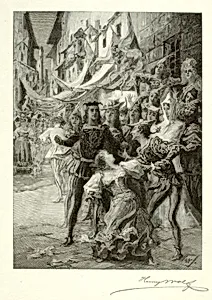
Medium
Graphic Arts-Print
Classification
Graphic Arts-Print
Department
Smithsonian Collection
Museum
Smithsonian American Art Museum
Credit
Smithsonian American Art Museum, Transfer from the Archives of American Art, Smithsonian Institution
Accession Number
1973.130.142
Rights
Public Domain
Tags
Art Historical Context
**Romola** is a captivating graphic arts print created by Henry Wolf in 1897, now housed in the Smithsonian American Art Museum. Wolf, a skilled engraver and etcher active in the late 19th century, was renowned for his intricate reproductive prints that brought paintings and illustrations to life through masterful line work. This piece, transferred from the Archives of American Art, exemplifies the era's fascination with printmaking as a democratic medium, allowing fine art to reach wider audiences beyond oil paintings. The artwork blends cityscape and figure group elements, likely depicting an urban scene alive with people amidst architectural details. In the Gilded Age context of 1897, such prints captured the bustling energy of modern cities, reflecting social dynamics and everyday life. Wolf's technique—precise incisions in metal plates for etching or engraving—produced rich tones and textures, highlighting his expertise in translating complex compositions into enduring images. As part of the Smithsonian Collection, *Romola* underscores the museum's commitment to preserving American graphic arts. It invites visitors to appreciate how prints bridged high art and popular culture, offering a window into turn-of-the-century visual storytelling. (178 words)