
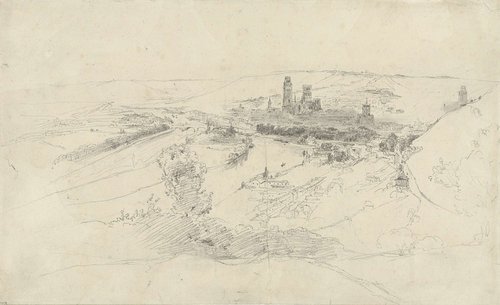
Rouaan temidden van heuvels langs de Seine
1822 - 1867
Medium
paper
Dimensions
297; 487
Rights
Public Domain
About this artwork
potlood
Art Historical Context
### Rouen Amidst Hills Along the Théodore Rousseau's *Rouaan temidden van heuvel langs de Seine* (likely depicting Rouen amidst hills along the Seine River) captures the serene beauty of the French countryside in a delicate pencil sketch on paper, measuring 297 × 487 mm. Created between 1822 and1867 during the artist's lifetime, this work reflects Rousseau's deep affinity for natural landscapes. As a leading figure in Barbizon School, Rousseau rejected the idealized scenes of Romanticism, instead embracing realistic depictions of nature drawn directly from observation—often en plein air. The pencil medium highlights Rousseau's masterful draftsmanship, allowing for subtle shading and intricate details that evoke the rolling hills and winding Seine. These sketches were vital to his process, serving as studies for larger oil paintings that championed the unvarnished truth of the outdoors. Executed on paper, it underscores the portability and immediacy of 19th-century landscape studies, bridging studio work with fieldwork. This piece offers visitors a glimpse into Rousseau's early influences from Normandy's river valleys, foreshadowing his iconic Fontainebleau forest scenes. Its quiet elegance invites contemplation of how such humble drawings fueled the Realist movement, transforming how we perceive the everyday sublime in nature.
About the Artist
Théodore Rousseau · 1812–1867
Théodore Rousseau (1812–1867) was a French landscape painter and the leading figure of the Barbizon School, the group of artists who settled in the village of Barbizon near the Forest of Fontainebleau to paint directly from nature. Born in Paris, he showed precocious talent and studied under the academic painters Charles Rémond and Guillaume Guillon-Lethière, but quickly rejected classical landsca...