
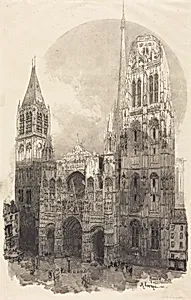
Rouen Cathedral (La Cathedral de Rouen)
1888
Medium
wood engraving
Classification
Department
CG-E
Museum
National Gallery of Art, Washington, D.C.
Credit
Rosenwald Collection
Accession Number
1943.3.5602
Rights
Public Domain
Art Historical Context
Auguste Lepère's *Rouen Cathedral (La Cathédrale de Rouen)*, created in 1888, the majestic Gothic silhouette of one of France's most iconic. This wood engraving depicts the cathedral's intricate facade against a moody sky, showcasing Lepère's skill as a master printmaker. A prominent French artist and engraver (18491918), Lepère was renowned for his detailed urban scenes and architectural views, often drawing from everyday French life during the Belle Époque era. Wood engraving, the medium here, allowed for exceptional precision through carving on the end-grain of hardwood blocks, producing fine lines ideal for reproductive prints in books and periodicals. This technique marked a revival in late 19th-century France, bridging traditional craftsmanship with emerging modern graphic arts. Lepère's work reflects a fascination with light, texture, and monumental architecture, echoing the era's interest in national heritage amid rapid industrialization. Housed in the National Gallery of Art's Rosenwald Collection, this print highlights Rouen Cathedral's enduring cultural symbolism—a UNESCO site today, it inspired artists like Monet. Visitors will appreciate its technical virtuosity and timeless evocation of medieval grandeur in a compact, intricate form.
About the Artist
Auguste Lepère · 1849–1918
Auguste-Louis Lepère (1849–1918), son of the sculptor François Lepère, was born in Paris on November 30, 1849, into an artistic family that shaped his early path. At age thirteen, he apprenticed in the Paris studio of the English wood engraver Joseph Burn Smeeton, honing his skills in wood engraving until 1867. He furthered his training with drawing classes under Horace Lecoq de Boisbaudran at the...