
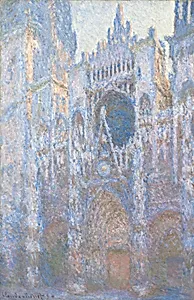
Rouen Cathedral, West Façade
1894
Medium
oil on canvas
Dimensions
overall: 100.1 x 65.9 cm (39 3/8 x 25 15/16 in.) framed: 121.6 x 88.3 cm (47 7/8 x 34 3/4 in.)
Classification
Painting
Department
CF
Museum
National Gallery of Art, Washington, D.C.
Credit
Chester Dale Collection
Accession Number
1963.10.49
Rights
Public Domain
Art Historical Context
Claude Monet's *Rouen Cathedral, Westçade* (1894) is a luminous gem from his celebrated Rouen Cathedral series, where the artist obsessively captured the Gothic masterpiece in Normandy under varying light and weather. Painted during a period of intense experimentation in Giverny, this oil on canvas (100.1 x 659 cm) exemplifies Monet Impressionist mission to portray the ephemeral effects of atmosphere rather than static form. He produced around 30 views between 1892 and 1894, each a meditation on how sunlight transforms stone into a symphony of color. Monet's technique—loose, vibrant brushstrokes and a palette of blues, golds, and pinks—dissolves the cathedral's architecture into shimmering patterns, prioritizing sensation over precise detail. This approach challenged traditional academic painting, influencing modern art's emphasis on perception and subjectivity. Housed in the National Gallery of Art's Chester Dale Collection, it invites viewers to experience time's passage on canvas. Fun fact: Monet worked from a nearby apartment window, returning daily to chase fleeting light, blending devotion to nature with architectural grandeur. A must-see for understanding Impressionism's revolutionary spirit!
About the Artist
Claude Monet · 1840–1926
Claude Monet, born Oscar-Claude Monet on November 14, 1840, in Paris and raised in Le Havre, Normandy, began his artistic journey as a successful teenage caricaturist. His formal training started at the Le Havre secondary school of the arts in 1851, where he received his first drawing lessons from Jacques-François Ochard. Around 1858, he met Eugène Boudin, who became his pivotal mentor, introducin...