
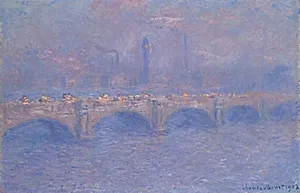
Waterloo Bridge, Sunlight Effect
1903
Medium
Oil on canvas
Dimensions
65.7 × 101 cm (25 7/8 × 39 3/4 in.); Framed: 88.9 × 123.2 × 10.8 cm (35 × 48 1/2 × 4 1/4 in.)
Classification
painting
Department
Painting and Sculpture of Europe
Museum
Art Institute of Chicago
Accession Number
20701
Rights
Public Domain
About this artwork
If not for the fog, Claude Monet once remarked, “London wouldn’t be a beautiful city. It’s the fog that gives it its magnificent breadth.” While working on his London Series, he rose early every day to paint Waterloo Bridge in the morning, moving on to Charing Cross Bridge at midday and in the afternoon. He observed both motifs from his fifth-floor window at the Savoy Hotel. The Art Institute’s two Waterloo Bridge paintings are dated 1900 and 1903, but both were likely begun in 1900 and dated on...
Art Historical Context
Claude Monet's *Waterloo Bridge,light Effect* (1903) captures the iconic London landmark bathed in a radiant glow, part of the artist's renowned series painted from his Savoy Hotel window. During multiple trips to England around 1900–1904, Monet was mesmerized by the Thames River's misty atmosphere, producing over 40 variations of Waterloo Bridge, Charing Cross Bridge, and the Houses of Parliament. This on canvas exemplifies his Impressionist obsession with ephemeral light and weather, transforming industrial London into a dreamlike haze of purples, pinks, and golds. Monet's loose, dappled brushstrokes dissolve forms into vibrating color patches, prioritizing sensation over detail—a hallmark of Impressionism that revolutionized painting by depicting modern urban life as perceived by the eye. The sunlight pierces through fog, creating a luminous "effect" that blurs the bridge's structure, inviting viewers to feel the transient magic of a momentary vista. Housed in the Art Institute of Chicago's Department of Painting and Sculpture of Europe, this 65.7 × 101 cm masterpiece (65.7 × 101 cm) invites us to ponder how Monet turned pollution-choked air into poetry, bridging 19th-century Paris salons with 20th-century modernism. A must-see for its joyful embrace of light's alchemy!
About the Artist
Claude Monet · 1840–1926
Claude Monet, born Oscar-Claude Monet on November 14, 1840, in Paris and raised in Le Havre, Normandy, began his artistic journey as a successful teenage caricaturist. His formal training started at the Le Havre secondary school of the arts in 1851, where he received his first drawing lessons from Jacques-François Ochard. Around 1858, he met Eugène Boudin, who became his pivotal mentor, introducin...