
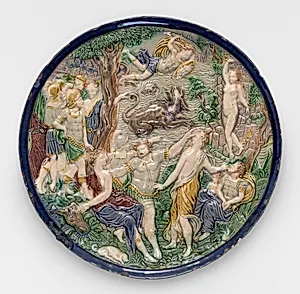
Round Plate with Perseus and Andromeda
late 16th/early 17th century
Medium
lead-glazed earthenware
Dimensions
overall: 30.5 × 26 cm (12 × 10 1/4 in.)
Classification
Decorative Art
Department
CSD
Museum
National Gallery of Art, Washington, D.C.
Credit
Corcoran Collection (William A. Clark Collection)
Accession Number
2015.19.4066
Rights
Public Domain
Art Historical Context
This exquisite round plate, titled *Round Plate with Perseus Andromeda*, hails from the Fontainebleau Pottery workshop and reflects the style of Bernard Palissy, the renowned 16th-century French ceramist. Created in the late 16th or 17th century, measures just 30.5 × 26 cm, making it a intimate yet striking piece of decorative art. The central motif draws from classical mythology: the hero Perseus rescuing the chained princess Andromeda from a sea monster, a popular Renaissance subject symbolizing heroism and divine intervention. Crafted from lead-glazed earthenware, the plate showcases Palissy's influential "rustic" technique—vibrant, multicolored glazes over molded reliefs that brought lifelike texture to ceramics. Followers at Fontainebleau, inspired by the Mannerist elegance of the royal château, adapted this method to blend naturalism with mythological narratives, elevating everyday objects into sculptural treasures. Lead glazing allowed for jewel-toned hues and durability, revolutionizing French pottery during a time when Italian influences flooded the courts. Now part of the National Gallery of Art's Corcoran Collection (William A. Clark Collection), this plate offers a window into Renaissance innovation, where art met utility in the hands of master potters. Visitors, admire how its glossy surface still captures the drama of ancient tales!