
Roundel with Saint John the Baptist
ca. 1520 or modern
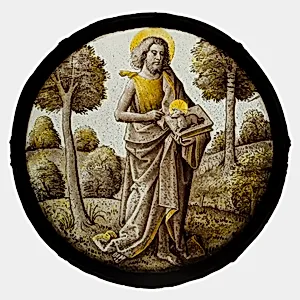
Medium
Colorless glass, silver stain, vitreous paint
Dimensions
Overall Diam.: 9 1/2 in. (24.1 cm)
Classification
Glass-Stained
Culture
South Netherlandish
Department
The Cloisters
Museum
Metropolitan Museum of Art, New York, NY
Credit
The Cloisters Collection, 1932
Accession Number
32.24.26
Rights
Public Domain
Tags
Art Historical Context
This exquisite stained glass roundel, *Roundel with Saint John the Baptist and attributed to the Pseudo-Ortkens workshop,ails from the South Netherlandish tradition around 1520—or possibly a fine modern reproduction. Measuring 9 1/2 inches in, it captures the revered saint, likely accompanied by the symbolic Lamb of God, a motif evoking John's proclamation of Christ as the "Lamb who takes away the sin of the world" (John 1:29). Such roundels were prized in Renaissance-era homes across the Low Countries, adorning secular windows or overmantels to bring spiritual elegance into daily life, blending piety with decorative artistry. Crafted from colorless glass enhanced by silver stain—a technique yielding luminous yellows and golds—and vitreous paint for fine details, the piece exemplifies Netherlandish mastery. The silver stain, fired into the glass, created rich tonal effects without colored pot metal, allowing light to dance through in ethereal glows. Housed in The Cloisters at the Metropolitan Museum of Art since 1932, this work highlights the enduring appeal of stained glass beyond cathedrals, offering visitors a window into 16th-century devotion and craftsmanship. Whether period or revival, its vivid imagery invites quiet reflection on faith's gentle symbols.
About the Artist
Pseudo-Ortkens · 1500–1530
**Pseudo-Ortkens** (also known as Pseudo-Aert Ortkens) is the conventional name given to a workshop or group of South Netherlandish artists active in the Southern Netherlands, particularly around Antwerp and Brussels, from approximately 1500 to 1540. The name arose after earlier attributions to the glass painter Aert Ortkens (Arnold of Nijmegen) proved erroneous; scholars now recognize the output ...