
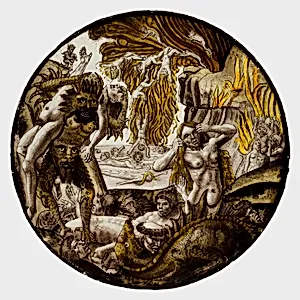
Roundel with Souls Tormented in Hell
1500–1510
Medium
Colorless glass, silver stain, vitreous paint
Dimensions
Overall Diam.: 8 7/8 in. (22.5 cm) --without lead
Classification
Glass-Stained
Culture
South Netherlandish
Department
The Cloisters
Museum
Metropolitan Museum of Art, New York, NY
Credit
The Cloisters Collection, 1932
Accession Number
32.24.43
Rights
Public Domain
Tags
Art Historical Context
In the dim glow of a Gothic chapel, this striking *Roundel with Souls Tormented in Hell by Dieric Bouts transports visitors to the fiery visions of late medieval piety. Crafted in South Netherlandish workshops around 1500–0, the 8⅞-inch colorless glass roundel vividly captures damned souls writhing amid demons, their naked forms—especially the female nudes—emphasizing vulnerability and eternal suffering. Such circular panels were popular decorative elements in domestic or ecclesiastical settings, serving as moral reminders of the afterlife's perils. Bouts, a master of the Northern Renaissance known for meticulous realism, likely influenced this work from his circle, employing innovative stained-glass techniques: silver stain for luminous yellows and oranges, and vitreous paint for shadowy details, fired onto the glass for durability. These methods allowed intricate narratives on a small scale, blending transparency with vivid color to dramatic effect as light filtered through. Housed in The Cloisters at the Metropolitan Museum of Art, this piece reflects the era's obsession with salvation and sin, drawing from sermons and texts like Dante's *Inferno*. Its unflinching portrayal of hellfire not only showcases technical brilliance but also invites reflection on human frailty, making it a haunting highlight for those exploring medieval spirituality.