
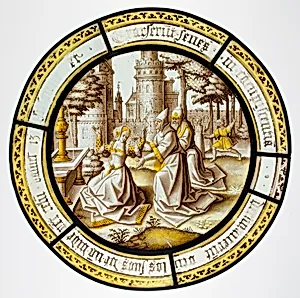
Roundel with Susannah and The Elders
ca. 1520
Medium
Colorless glass, vitreous paint and silver stain
Dimensions
Overall (with border): 13 in. (33 cm)
Classification
Glass-Stained
Culture
South Netherlandish
Department
The Cloisters
Museum
Metropolitan Museum of Art, New York, NY
Credit
The Cloisters Collection, 1990
Accession Number
1990.119.1
Rights
Public Domain
Tags
Art Historical Context
This exquisite roundel, created around 1520 in the South Netherlands, captures the biblical story of Susannah and the Elders in a compact circular format. Attributed to the artist known as Pseudo-Ortkens, whose workshop specialized in such designs, the piece reflects the refined glass-painting traditions of the early sixteenth century. As part of the Metropolitan Museum’s Cloisters collection, it offers visitors a glimpse into the devotional and decorative arts that once adorned both churches and private homes in the region. The artwork’s medium—colorless glass enhanced with vitreous paint and silver stain—highlights an innovative technique popular in Netherlandish workshops. Silver stain, applied as a silver nitrate solution and fired onto the glass, produces luminous yellow and golden tones without the need for colored glass pieces. This method allowed artists to achieve delicate shading and intricate details within a single pane, making roundels both affordable and visually striking. Measuring just thirteen inches across, including its border, the roundel demonstrates how small-scale stained glass served intimate settings while conveying complex narratives. Its survival and careful preservation underscore the enduring appeal of these luminous works from the South Netherlandish school.
About the Artist
Pseudo-Ortkens · 1500–1530
**Pseudo-Ortkens** (also known as Pseudo-Aert Ortkens) is the conventional name given to a workshop or group of South Netherlandish artists active in the Southern Netherlands, particularly around Antwerp and Brussels, from approximately 1500 to 1540. The name arose after earlier attributions to the glass painter Aert Ortkens (Arnold of Nijmegen) proved erroneous; scholars now recognize the output ...