
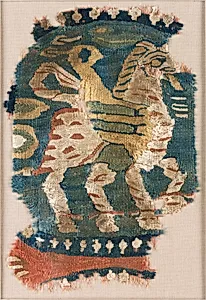
Roundel with Winged Horse
Unknown Artist
9th century
Medium
Wool, linen; tapestry weave
Dimensions
Textile: H. 10 1/2 in. (26.7 cm) W. 7 1/4 in. (18.4 cm) Mount: H. 22 1/2 in. (57.2 cm) W. 16 1/2 in. (41.9 cm)
Classification
Textiles-Woven
Department
Islamic Art
Museum
Metropolitan Museum of Art, New York, NY
Credit
Rogers Fund, 1974
Accession Number
1974.113.7
Rights
Public Domain
Tags
Art Historical Context
Nestled in the Metropolitan Museum of Art's Islamic collection, this *Roundel with Winged* is a exquisite example of 9th-century artistry. Crafted from wool and linen tapestry weave—a labor-intensive technique where colored weft threads are woven to create intricate patterns without floats—this small roundel (10½ × 7¼ inches) likely served as a decorativeallion on garments, furnishings, or ceremonial objects. Its compact size belies the skill involved, as weavers interlocked yarns to produce vibrant, durable designs suited for everyday luxury in the Islamic world. Dating to the Abbasid era, when Islamic culture flourished across the Middle East and beyond, the artwork features a mythical winged horse—a motif echoing pre-Islamic Persian and Central Asian traditions. Such fantastical creatures symbolized power, speed, and the divine, often appearing in textiles traded along Silk Road routes. The roundel's circular format, common in Islamic decorative arts, evokes harmony and eternity, blending technical mastery with symbolic depth. Acquired through the Rogers Fund in 1974, this piece invites us to marvel at the anonymous artisans whose woven wonders preserved cultural narratives through centuries. A testament to Islamic textile innovation, it highlights how everyday materials became canvases for imagination.