
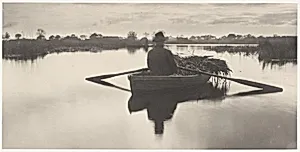
Rowing Home the Schoof-Stuff
Medium
Platinum print from glass negative
Dimensions
Image: 13.8 x 27.9 cm (5 7/16 x 11 in.) Mount: 28.6 x 41 cm (11 1/4 x 16 1/8 in.) Sheet (Interleaving Plate Sheet): 28.2 x 40.8 cm (11 1/8 x 16 1/16 in.)
Classification
Photographs
Department
Photographs
Museum
Metropolitan Museum of Art, New York, NY
Credit
Gilman Collection, Purchase, Mrs. Walter Annenberg and The Annenberg Foundation Gift, 2005
Accession Number
2005.100.726
Rights
Public Domain
Tags
Art Historical Context
Peter Henry Emerson’s “Rowing Home the Schoof-Stuff” captures a quiet moment of rural labor on the Norfolk Broads in 1886. Two men row a small boat laden with cut reeds—known locally as “schoof-stuff”—toward the shore at day’s end. The platinum print’s soft, silvery tones and wide tonal range lend the scene a luminous, almost painterly quality, emphasizing the gentle ripples of water and the vast, open sky. Emerson, a pioneering British photographer and advocate of “naturalistic photography,” created this image as part of his groundbreaking book *Life and Landscape on the Norfolk Broads*. He championed straightforward depictions of everyday life over staged or heavily manipulated pictures, using large-format glass negatives to record authentic moments in the East Anglian landscape. The platinum process he favored produced prints with exceptional depth and permanence, allowing subtle gradations of light and texture to convey both the physical effort of the rowers and the serene beauty of their surroundings. Today the work stands as an early landmark in photography’s recognition as a fine art. Its sensitive portrayal of working life and masterful handling of the platinum medium continue to invite viewers to appreciate the quiet dignity of traditional rural practices at the close of the nineteenth century.
About the Artist
Peter Henry Emerson · 1856–1936
Peter Henry Emerson (1856–1936) was born on May 13 at his family's sugar plantation, La Palma Estate, near Encrucijada, Cuba, to an American father, Henry Ezekiel Emerson, and British mother, Jane Harris Billing. A distant relative of Ralph Waldo Emerson and Samuel Morse, he spent his early childhood amid the island's landscapes before moving to Wilmington, Delaware, during the American Civil War ...