
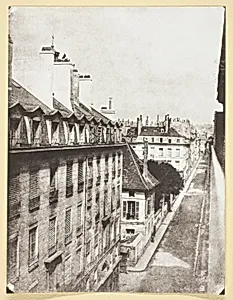
Rue Cambon
1846, printed 1965
Medium
Gelatin silver print, No. 16 from the portfolio "Bayard: XXV Calotypes, 1842-1850" (1965)
Dimensions
Image/paper/mount: 22.6 × 17.2 cm (8 15/16 × 6 13/16 in.)
Classification
photographic process
Department
Photography and Media
Museum
Art Institute of Chicago
Accession Number
23793
Rights
Public Domain
Art Historical Context
Step into the bustling streets of 1840s Paris with *Rue Cambon*, a captivating calotype by pioneering photographer Hippolyte Bayard, captured in 1846. Bayard, a French civil servant turned innovator, was a key figure in photography's infancy, rivaling contemporaries like Daguerre and Talbot. This image, part of the rare 1965 portfolio *Bayard: XXV Calotypes, 1842-1850*, offers a glimpse of everyday urban life on Rue Cambon, a fashionable thoroughfare near the Tuileries Garden, frozen in time through his experimental lens. Printed as a modern gelatin silver print (22.6 × 17.2 cm), it reproduces Bayard's original calotype process—a paper negative technique that produced soft, painterly tones with subtle textures, distinguishing it from sharper daguerreotypes. This medium's significance lies in its reproducibility, allowing multiple prints from one negative, a breakthrough for photography as art. Bayard's work underscores photography's cultural shift from scientific novelty to documentary poetry, immortalizing Paris's evolving modernity. Housed in the Art Institute of Chicago's Photography and Media department, *Rue Cambon* invites visitors to ponder how these fragile early images laid the foundation for visual storytelling we cherish today.
About the Artist
Hippolyte Bayard · 1801–1887
Hippolyte Bayard (1801–1887) was a French civil servant and artist who holds a remarkable, if bittersweet, place in the history of photography: he was one of the independent inventors of the photographic process in the late 1830s, developing his own direct positive paper print method at virtually the same moment that Louis Daguerre and William Henry Fox Talbot were arriving at their own solutions ...