
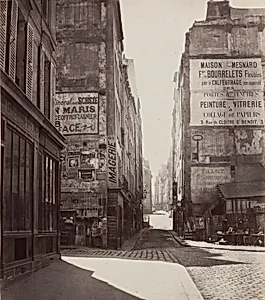
Rue Saint-Jacques
1864–before February 1867
Medium
albumen print
Dimensions
image/sheet: 30.6 × 27 cm (12 1/16 × 10 5/8 in.) mount: 60 × 42.6 cm (23 5/8 × 16 3/4 in.)
Classification
Photograph
Department
CPH
Museum
National Gallery of Art, Washington, D.C.
Credit
Robert B. Menschel Fund
Accession Number
2003.17.1
Rights
Public Domain
Art Historical Context
Step into the bustling heart of 19th-century Paris with Marville's *Rue Saint-Jacques*, an evocative albumen print created between 1864 and February 1867. 30.6 × 27 cm image captures a narrow street scene in the Latin Quarter, alive with the grit and charm of old Paris—cobblestones, shadowed facades, and everyday life frozen in time. Marville, the city's official photographer under Napoleon III masterfully documented these vanishing urban vignettes, offering us a window into a world on the cusp of transformation. During Baron Georges-Eugène Haussmann's sweeping renovations, which razed medieval alleys to build grand boulevards, Marville's work became an invaluable record of Paris's pre-modern face. Commissioned by the city, his photographs preserved architectural details and street atmospheres that modernization erased, blending documentary precision with artistic sensitivity. As a pioneer in urban photography, he elevated the medium from mere record-keeping to cultural heritage. The albumen print technique, using egg whites to bind light-sensitive chemicals on paper, yields the rich tonal depth and sharp clarity that make this piece so immersive. Housed in the National Gallery of Art's photography collection (thanks to the Robert B. Menschel Fund), *Rue Saint-Jacques* reminds us how photography captured history's fleeting moments, inviting reflection on progress and loss.
About the Artist
Charles Marville · 1813–1879
**Charles Marville**, born Charles François Bossu on July 17, 1813, in Paris, adopted his professional pseudonym around 1832 to avoid the stigma of "bossu," meaning hunchback in French. Trained as a painter, engraver, and illustrator, he spent nearly two decades producing woodblock illustrations for books and magazines before embracing photography around 1850. His transition coincided with the med...