
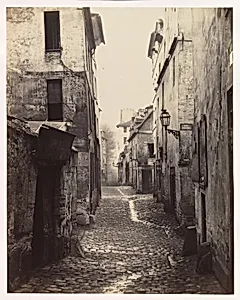
Rue Traversine (from the Rue d'Arras)
ca. 1868
Medium
Albumen silver print from glass negative
Dimensions
34.8 x 27.5 cm (13 11/16 x 10 13/16 in. )
Classification
Photographs
Department
Photographs
Museum
Metropolitan Museum of Art, New York, NY
Credit
Gift of Howard Stein, 2010
Accession Number
2010.513.2
Rights
Public Domain
Tags
Art Historical Context
Step into the shadowy lanes of old Paris with *Rue Traversine (from the Rue dras)*, a captivating albumen silver print by Charles Marville, created 1868. This 34.8 x 27.5 cm photograph captures a narrow, winding alleyway lined with weathered buildings, evoking the intimate, medieval fabric of the city before its dramatic transformation. Marville, Paris's official photographer under Napoleon III, masterfully used a glass negative to produce the rich tonal depth and exquisite detail characteristic of albumen prints—the dominant photographic process of the era, prized for its clarity and subtle gradations. Commissioned to document the capital's vanishing streets ahead of Baron Haussmann's sweeping urban renewal, this image preserves a slice of pre-modern Paris. Rue Traversine, a tiny thoroughfare off Rue d'Arras, was soon demolished to make way for wide boulevards, turning Marville's work into an invaluable historical archive. His precise, objective style—part of 19th-century documentary photography—elevates these scenes beyond mere records, offering a poignant glimpse into everyday urban life amid profound change. Today, housed in the Metropolitan Museum of Art (gift of Howard Stein, 2010), it reminds us how photography can freeze time, bridging viewers to a lost world of cramped streets and timeless stone facades. A must-see for lovers of architectural history!
About the Artist
Charles Marville · 1813–1879
**Charles Marville**, born Charles François Bossu on July 17, 1813, in Paris, adopted his professional pseudonym around 1832 to avoid the stigma of "bossu," meaning hunchback in French. Trained as a painter, engraver, and illustrator, he spent nearly two decades producing woodblock illustrations for books and magazines before embracing photography around 1850. His transition coincided with the med...