
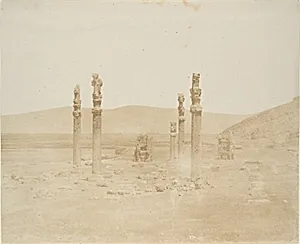
Ruine sulla prima terrazza, Persepolis
1858
Medium
Salted paper print from paper negative
Classification
Photographs
Department
Photographs
Museum
Metropolitan Museum of Art, New York, NY
Credit
Gift of Kay Gregory, 1967
Accession Number
67.606.16
Rights
Public Domain
Tags
Art Historical Context
"Ruine sulla prima terrazza, Persepolis" (Ruins on the First Terrace, Persepolis), captured by Italian photographer Luigi Pesce in 1858, offers a haunting glimpse into the majestic ruins of ancient Persepolis, the ceremonial capital of the Achaemenid Persian Empire. Built around 515 BCE by Darius I, Persepolis stood as a symbol of imperial grandeur with its towering columns and intricate reliefs, until its destruction by Alexander the Great in 330 BCE. Pesce, one of the pioneering photographers to document the Middle East, ventured to these remote terraces, framing the weathered columns against a vast, timeless landscape that evokes the empire's faded glory. This salted paper print, made from a paper negative, exemplifies early calotype photography—a process invented by William Henry Fox Talbot in the 1840s. The technique produced soft, textured images with rich tonal gradations, ideal for capturing architectural details and atmospheric light. Unlike sharper daguerreotypes, salted paper prints allowed for larger formats and multiples, making distant wonders accessible to European audiences hungry for exotic exploration. Pesce's work holds historical significance as part of 19th-century photographic expeditions that bridged East and West, preserving Persepolis before modern excavations. Today, housed in the Metropolitan Museum of Art thanks to a 1967 gift from Kay Gregory, it reminds visitors of photography's power to immortalize cultural heritage amid encroaching time and sand.
About the Artist
Luigi Pesce · 1818–1891
**Luigi Pesce (1828–1864)** was an Italian colonel and pioneering amateur photographer from Naples in the Kingdom of the Two Sicilies, whose work captured some of the earliest images of Iran's ancient monuments and 19th-century life. Arriving in Persia in 1848 during the reign of Naser al-Din Shah Qajar, Pesce was tasked with training Iranian infantry units, a mission that positioned him ideally t...