
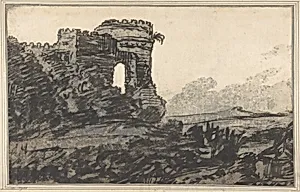
Ruined Castle and Trees
ca. 1762
Medium
Graphite, brush and black ink, gray and brown wash; laid down on original paper mount with gray wash
Dimensions
Sheet: 10 1/2 × 16 3/4 in. (26.6 × 42.6 cm) Mount: 15 1/8 in. × 20 7/8 in. (38.4 × 53.1 cm)
Classification
Drawings
Department
Drawings and Prints
Museum
Metropolitan Museum of Art, New York, NY
Credit
Harris Brisbane Dick Fund, 1930
Accession Number
30.49.11
Rights
Public Domain
Tags
Art Historical Context
Alexander Cozens's *Ruined Castle and Trees* (. 1762) captures the evocative beauty of decay and nature in a masterful landscape drawing. Created during the height of 18th-century British interest in the Picturesque, this work features a crumbling castle overtaken by sturdy trees, evoking a of timeless melancholy and the sublime power of the natural world reclaiming human structures. Cozens, a Russian-born English artist and influential drawing master, was renowned for his innovative approaches to landscape depiction, blending observation with imaginative composition. Executed in graphite, brush and black ink, with subtle gray and brown washes, the drawing exemplifies the delicate techniques of the period's topographical art. The layered washes add depth and atmospheric mood, while the original paper mount with its gray wash border enhances its presentation as a finished study. Housed in the Metropolitan Museum of Art's Drawings and Prints department since 1930, this piece reflects the era's fascination with ruins as symbols of historical grandeur and ephemerality—think Gothic Revival stirrings and early Romantic sensibilities. At 10½ × 16¾ inches, it's intimate yet immersive, inviting visitors to ponder how Cozens transformed simple media into a poignant meditation on time and wilderness. A gem for fans of atmospheric landscapes!
About the Artist
Alexander Cozens · 1717–1786
Alexander Cozens (1717–1786) was a pioneering British landscape painter in watercolours, born in Saint Petersburg, Russia, to English shipbuilder Richard Cozens, who served Peter the Great—the tsar even stood as Alexander's godfather. Educated in England from age ten, he returned to Russia before embarking on a formative journey in 1746, sailing to Italy where he worked in the studio of the esteem...