
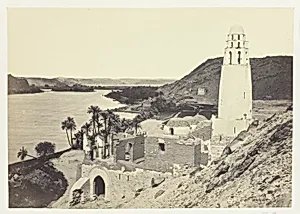
Ruined Mosque Near Philæ
1857
Medium
Albumen print, pl. 24 from the album "Egypt and Palestine, Volume I" (1858)
Dimensions
Image/paper: 16.2 × 22.9 cm (6 7/16 × 9 1/16 in.); Album page: 28.8 × 42.6 cm (11 3/8 × 16 13/16 in.)
Classification
photograph
Department
Photography and Media
Museum
Art Institute of Chicago
Accession Number
157956
Rights
Public Domain
Art Historical Context
Step into the sun-drenched of 19th-century Egypt with Frith's *Ruined Mosque Near Phil* (1857), an exquisite albumen print from his album *Egypt and Palestine Volume I* (1858). Captured during Frith's pioneering expeditions to the Middle East, this 16.2 × 22.9 cm image showcases the weathered beauty of a dilapidated mosque on the island of Philae, near the Nile River's ancient temples. Frith, a trailblazing British photographer, ventured where few had before, using bulky cameras to immortalize remote archaeological wonders for eager Victorian audiences back home. The albumen process—coating paper with egg whites and silver salts—lends the photograph its signature warm tones, sharp details, and luminous glow, hallmarks of early photography that made distant landscapes feel vividly present. As plate 24 in Frith's multi-volume series, it contributed to a visual revolution, popularizing travel photography and fueling Western fascination with Egypt's layered history, from pharaonic ruins to Islamic heritage. Housed in the Art Institute of Chicago's Photography and Media Department, this print not only documents a vanishing architectural gem but also bridges cultures, inviting us to ponder the timeless allure of Philae's sacred landscape. A testament to Frith's adventurous spirit, it remains a window into an era of exploration and discovery.
About the Artist
Francis Frith · 1822–1898
Francis Frith (1822–1898) was born on 7 October 1822 in Chesterfield, Derbyshire, into a prosperous Quaker merchant family as the second child and only son of Francis Frith Sr. and Alice Walker. Educated at Quaker schools including Ackworth and Camp Hill in Birmingham from around 1828 to 1838, he apprenticed in the cutlery trade before establishing himself as a wholesale grocer in Liverpool, suppl...