
Ruined Tower
c. 1858
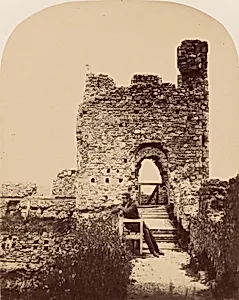
Medium
albumen print
Dimensions
image: 21.8 × 17.5 cm (8 9/16 × 6 7/8 in.) mount: 49 × 34.8 cm (19 5/16 × 13 11/16 in.)
Classification
Photograph
Department
CPH
Museum
National Gallery of Art, Washington, D.C.
Credit
Purchased as the Gift of the Richard King Mellon Foundation
Accession Number
2018.8.5
Rights
Public Domain
Art Historical Context
Frederick Scott Archer’s *Ruined Tower* (c. 1858) captures the haunting beauty of architectural remnants through the delicate tones of an albumen print. Archer, a pioneering British photographer who invented the wet-collodion process in 1851, helped transform photography from a novelty into a widely practiced art. This image, made just a few years after his innovation, reflects the Victorian fascination with picturesque ruins—subjects that evoked both the romance of the past and the inevitability of time’s passage. The albumen print medium itself marks an important chapter in photographic history. By suspending silver salts in egg-white emulsion on paper, photographers achieved richer detail and a glossy surface that enhanced depth and texture. Here, the technique renders crumbling stone and surrounding landscape with striking clarity, inviting viewers to linger over the contrast between enduring nature and fragile human construction. Acquired by the National Gallery of Art as a gift of the Richard King Mellon Foundation, *Ruined Tower* stands as a quiet testament to photography’s early artistic ambitions. Its modest scale and refined tonal range continue to reward close looking, offering modern audiences a glimpse of how nineteenth-century viewers first experienced the world through this new visual medium.
About the Artist
Frederick Scott Archer · 1813–1858
**Frederick Scott Archer** (1814–1857) was an English sculptor, chemist, and photographer best known for inventing the wet collodion process, which transformed photography by combining the sharp detail of the daguerreotype with the reproducibility of paper prints. Born on 30 August 1814 in Hertford, Hertfordshire, as the fifth son of a local butcher, Archer moved to London as a young man to appren...