
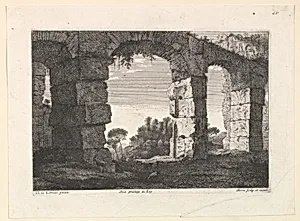
Ruines d'Aqueduc
Medium
Etching, first state
Dimensions
sheet: 7 5/16 x 10 11/16 in. (18.6 x 27.2 cm) image: 5 11/16 x 8 1/4 in. (14.4 x 21 cm)
Classification
Prints
Department
Drawings and Prints
Museum
Metropolitan Museum of Art, New York, NY
Credit
Harris Brisbane Dick Fund, 1945
Accession Number
45.35.14
Rights
Public Domain
Tags
Art Historical Context
This etching, titled *Ruines d'Aqueduc*, captures the allure of ancient Roman architecture through the lens of17th-century French printmaking. Created in the first state by Jean Morin after a design by Claude Lorrain (also known as Claude Gellée), it exemplifies the classical landscape tradition that defined Lorrain’s work. The artist, celebrated for his luminous depictions of the Italian countryside, often incorporated ruins to evoke nostalgia for antiquity and the harmony between nature and human achievement. As an etching, this print allowed wider audiences to appreciate Lorrain’s atmospheric compositions beyond his paintings. The modest scale—roughly the size of a small sheet of paper—made it suitable for collectors and connoisseurs of the period. First-state impressions like this one preserve the artist’s initial vision with crisp lines and delicate tonal contrasts before later reworkings altered the plate. Housed in the Metropolitan Museum of Art’s Department of Drawings and Prints, the work reflects the enduring cultural fascination with aqueducts as symbols of engineering prowess and the passage of time. Its acquisition through the Harris Brisbane Dick Fund in 1945 underscores the museum’s commitment to preserving these intimate yet evocative records of classical heritage.
About the Artist
Jean Morin|Claude Lorrain (Claude Gellée) · 1605–1650
Jean Morin (c. 1605–1650) was one of the most accomplished French engravers of the seventeenth century, a master of the portrait print whose work stands among the finest examples of French graphic art in its era. Little is known about his early life or training, though his technique suggests exposure to both French and Flemish engraving traditions, the latter being the dominant force in European p...