
Ruins and Trees
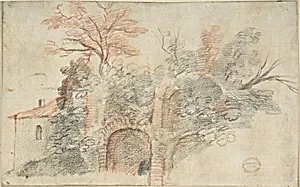
Medium
Red and black chalk on cream paper
Dimensions
4-5/8 x 7-5/16 in. (11.7 x 18.5 cm)
Classification
Drawings
Department
Drawings and Prints
Museum
Metropolitan Museum of Art, New York, NY
Credit
Gift of Cornelius Vanderbilt, 1880
Accession Number
80.3.552
Rights
Public Domain
Tags
Art Historical Context
Nestled among the treasures of the Metropolitan Museum of's Drawings and Prints department *Ruins and Trees* a delicate 17th-century sketch by anonymous Italian artist from the Roman-Bolognese. Rendered in red and black chalk on paper, this intimate 4-5/8 x 7-5/16-inch sheet captures the interplay of ancient ruins overgrown with sturdy trees, evoking the passage of time and nature's quiet reclaiming of human endeavors. The modest scale hints at a preparatory study, perhaps for a larger painting or etching, common in the era's artistic workshops. In the vibrant art scene of 17th-century Italy, Roman-Bolognese artists blended Rome's grand classical ruins—symbols of antiquity's glory—with Bologna's emphasis on naturalistic landscapes inspired by Carracci reformers. Red chalk, or sanguine, offered warm tonal modeling for flesh-like textures on bark and stone, while black chalk added crisp contrasts for depth and shadow. This dual technique exemplifies Baroque draftsmanship's precision, bridging observation and imagination in *capriccio*-style compositions that romanticized decay. A generous gift from Cornelius Vanderbilt in 1880, this drawing invites visitors to ponder how everyday sketches preserved the era's fascination with ruins, mirroring Europe's renewed interest in its classical past amid the Counter-Reformation's cultural fervor.