
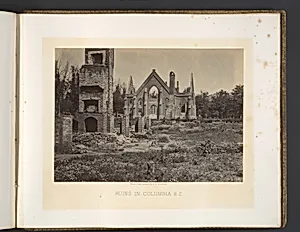
Ruins in Columbia, South Carolina
1860s
Medium
Albumen silver print from glass negative
Classification
Photographs
Department
Photographs
Museum
Metropolitan Museum of Art, New York, NY
Credit
Pfeiffer and Rogers Funds, 1970
Accession Number
1970.525 (54)
Rights
Public Domain
Tags
Art Historical Context
George N. Barnard's *Ruins in Columbia, South Carolina* (1860s) is a poignant albumen silver print from a glass negative, capturing the of the American Civil War As one of the era's pioneering photographers, Barnard documented the war's toll on the American South, using this wet-collodion process to produce sharp, richly toned images that preserved fleeting scenes of destruction. Albumen prints, coated with egg white for a glossy surface, were the gold standard of 19th-century photography, enabling detailed reproductions that brought distant horrors into sharp focus for viewers far away. This photograph depicts the charred remnants of Columbia, South Carolina, a city ravaged by fire during Union General William T. Sherman's 1865 March to the Sea. The image stands as a stark testament to the war's human and architectural cost, highlighting themes of ruin and resilience amid the conflict that claimed over 600,000 lives. Barnard's work, now in the Metropolitan Museum of Art's Photographs collection (acquired through the Pfeiffer and Rogers Funds in 1970), exemplifies early documentary photography's power to shape public memory and historical understanding. Through its unflinching gaze on twisted debris and skeletal structures, the print invites reflection on loss and rebuilding, offering visitors a visceral connection to Civil War history.
About the Artist
George N. Barnard · 1819–present
George N. Barnard (1819–1902) was a pioneering American photographer whose six-decade career spanned the dawn of the medium, from daguerreotypes to Civil War documentation. Born into a farming family in Coventry, Connecticut, on December 23, 1819, he lost his father at age seven and apprenticed in family businesses before marrying in 1843 and relocating to Oswego, New York. There, he launched one ...