
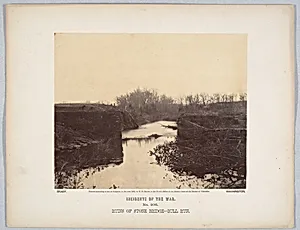
Ruins of Stone Bridge - Bull Run
1862
Medium
Albumen silver print from glass negative
Dimensions
Image: 18.8 × 23.1 cm (7 3/8 × 9 1/8 in.) Mount: 26.9 × 34.7 cm (10 9/16 × 13 11/16 in.)
Classification
Photographs
Department
Photographs
Museum
Metropolitan Museum of Art, New York, NY
Credit
Gilman Collection, Museum Purchase, 2005
Accession Number
2005.100.1130
Rights
Public Domain
Tags
Art Historical Context
In the scorched aftermath of the Second Battle of Bull Run—one of the bloodiest clashes of the American Civil War in August 1862—Mathew B. Brady's *Ruins of Stone Bridge - Bull Run* captures the devastation at a strategic crossing near Manassas, Virginia. Brady, a pioneering photographer often called the "father of photojournalism," dispatched teams to document the war's grim realities, bringing unprecedented visual evidence of conflict to Northern audiences. This stark image of the shattered stone bridge, amid tangled debris and scarred earth, underscores the war's toll on infrastructure and human endeavor, evoking the Union's early setbacks. Printed as an albumen silver print from a glass negative, the work exemplifies mid-19th-century photographic innovation. Albumen, derived from egg whites, coated paper for sharp, luminous details with a warm tonal range, allowing Brady's large-format views to convey both intimate textures—like weathered stone and splintered timbers—and epic scale. At 18.8 × 23.1 cm, it's intimate yet immersive, part of The Metropolitan Museum of Art's Gilman Collection. Brady's unflinching battlefield series shattered romanticized notions of war, influencing public opinion and journalism. This poignant ruin not only records history but invites reflection on fragility and resilience, a timeless testament to photography's power.
About the Artist
Mathew B. Brady · 1823–1896
Mathew B. Brady (c. 1823–1896) was an American photographer who became the most famous photographer of the Civil War era and one of the founding figures of American photographic history. Born in Warren County, New York, to Irish immigrant parents, he learned the daguerreotype process from Samuel F.B. Morse and William Page and opened his first portrait studio in New York City in 1844. Brady quick...