
Ruins of the Tuileries Palace
1871
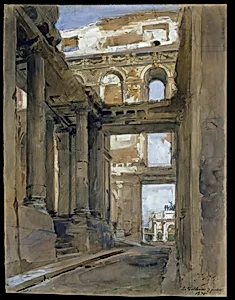
Medium
Gouache, watercolor, and graphite on light brown paper
Dimensions
19 9/16 x 14 15/16 in. (49.8 x 38.0 cm)
Classification
Drawings
Department
Drawings and Prints
Museum
Metropolitan Museum of Art, New York, NY
Credit
Purchase, Karen B. Cohen Gift, in memory of Lawrence Turčić, 1988
Accession Number
1988.144
Rights
Public Domain
Tags
Art Historical Context
In 1871, amid the chaotic final days of the Paris Commune—an uprising against the French government that gripped the city in revolution—Isidore Pils captured the devastation of the Tuiler Palace in this poignant drawing. The once-grand royal residence, a symbol of monarchical power from the 16th century, was ablaze by Communard forces in May, reducing its opulent halls to skeletal ruins Pils, a respected academic painter known for his scenes and murals, documented this pivotal moment with a directness that underscores the Commune's turbulent legacy, blending eyewitness urgency with artistic precision. Executed in gouache, watercolor, and graphite on light brown paper, the work's mixed media enhances its evocative power. Gouache provides bold, opaque highlights for the crumbling stone and charred debris, while translucent watercolor layers suggest lingering smoke and shadow. The warm brown support mimics scorched earth, amplifying the scene's somber mood. At nearly 20 by 15 inches, this intimate drawing invites close contemplation of destruction's aftermath. Housed in the Metropolitan Museum of Art's Drawings and Prints department, Pils's *Ruins of the Tuileries Palace* (acquired in 1988) offers a rare, on-the-ground glimpse into a defining episode of modern French history, reminding visitors of art's role in preserving fleeting truths amid upheaval.
About the Artist
Isidore Pils · 1813–1875
Isidore-Alexandre-Augustin Pils (1813/15–1875), born in Paris to the soldier François Pils, emerged as a leading French academic painter known for religious and military subjects. At age twelve, he studied under Guillaume Guillon-Lethière for four years before entering the École des Beaux-Arts in 1831 as a student of François-Édouard Picot. His talent secured the prestigious Prix de Rome in 1838 w...