
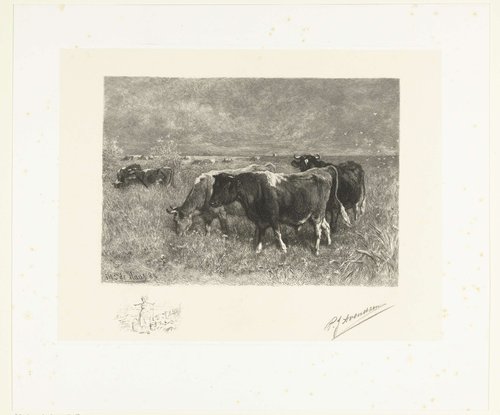
Runderen in een weiland
1884 - 1909
Medium
etching
Dimensions
340; 245
Rights
Public Domain
About this artwork
verzamelaarsmerk, verso midden, gestempeld: Lugt 2228
Art Historical Context
Petrus Johannes Arendzen’s *Runderen in een weiland* (“Cows in a Meadow”) captures a tranquil pastoral scene through the delicate medium of etching. Created between 1884 and 1909, the print measures roughly 24.5 by 34 centimeters and exemplifies the Dutch tradition of celebrating the countryside. Arendzen, active during the late nineteenth and early twentieth centuries, employed etching’s fine lines and tonal contrasts to render grazing cattle and open fields with quiet realism, inviting viewers to appreciate the subtle textures of grass, hide, and sky. Etching enjoyed renewed popularity in this period as both an original art form and a means of reproducing contemporary paintings. Arendzen’s choice of subject aligns with the enduring Dutch fascination for rural life, echoing earlier masters while reflecting the era’s interest in natural observation. The presence of the collector’s stamp (Lugt 2228) on the reverse further hints at the print’s journey through private collections, underscoring its appeal to connoisseurs of graphic art. This modest yet evocative work offers museum visitors a window into the quiet beauty of the Dutch landscape and the technical refinement of late-nineteenth-century printmaking.
About the Artist
Petrus Johannes Arendzen · 1855–1935
Petrus Johannes Arendzen (1846–1932) was a Dutch etcher, draughtsman, and painter who dedicated his career to creating reproductive etchings of Dutch paintings in English collections while living in England from 1873 onward. Born in Amsterdam in 1846, Arendzen married Epiphania, daughter of Johan Stracké, and left his native city to pursue a unique commission from the Dutch Government: to copy the...